Key Takeaways
- Network eavesdropping is the unauthorized capture of network traffic, usually without leaving a trace.
- Passive network interception, such as packet sniffing, differs greatly from active man-in-the-middle attacks that alter traffic.
- Encryption alone will not stop eavesdropping. Authenticating the device and network first closes the gap passive capture relies on.
How would you know if someone was reading your organization’s network traffic right now? For most, the answer is: you wouldn’t.
Network eavesdropping, the passive capture of traffic by someone who was never meant to see it, doesn’t alter or block anything in transit. The network continues to function normally, which is precisely why this class of attack is so difficult to detect and so commonly underestimated.
Every packet that crosses a Wi-Fi connection, an unencrypted VPN tunnel or a switch port is a potential target.
This article breaks down how passive interception works, the vectors enterprise networks tend to overlook, and why encryption and VPNs alone aren’t enough.
What Is Network Eavesdropping?
Network eavesdropping is the unauthorized, passive interception of data as it travels across a network. This can be Wi-Fi, a wired switch port or the public internet.
The attacker positions themselves somewhere the traffic naturally passes, whether that’s a mirrored switch port, a shared wireless medium or a compromised device already on the segment. Since no packets are dropped and no fields are rewritten, the connection between both legitimate endpoints looks as expected.
Network eavesdropping covers a range of techniques that share a common goal: read traffic without being noticed.
Techniques include:
- Tapping a physical link
- Running a packet analyzer on a compromised host
- Standing up a rogue wireless access point that legitimate devices connect to by mistake
What ties these techniques together? The attacker only watches. If they start injecting or altering packets, eavesdropping turns into active interception.
See your security gap before attackers do.
See continuous trust in action on a platform that includes RADIUS, PKI and AI security.
How Network Eavesdropping Works: Passive Interception vs. Active MITM Attacks
Passive and active attacks are different problems that require different solutions. The fix for one does not automatically fix the other. Treating these attack types as one blurs the distinction and makes defending against both more difficult.
Passive Interception Does Not Touch the Traffic
Passive interception means the attacker only reads the traffic.
Examples include a network tap spliced into a physical link and a network sniffer running in promiscuous mode. A rogue access point is the hybrid case: the attacker actively impersonates a network to reach a capture position, then reads passively once devices join.
Passive interception rarely produces an alert, since nothing in the traffic changes.
The lack of a dropped connection, failed login or latency spike means there’s nothing for an intrusion system to flag.
Active Man-in-the-Middle (MITM) Attacks Go a Step Further
An active man-in-the-middle (MITM) attack involves inserting the attacker between two parties. This allows the attacker to read, alter, block or redirect traffic in real time.
MITM is a meaningfully different type of attack with its own tells, such as unexpected redirects and certificate warnings.
For a closer look at how one common active MITM technique, the evil twin attack, exploits weak 802.1X configurations, see the video below.
In this article, we’ll be focusing on passive capture instead of active interception.
Common Attack Vectors for Network Eavesdropping
Passive interception is not one technique. Rather, it is a handful of distinct vectors, and enterprise networks are exposed to more of them than most teams assume.
Network Sniffing and Packet Analyzers
A packet analyzer captures every frame that reaches a network interface, whether that interface sits on a switch, a router or a laptop with a compromised network card.
On a poorly segmented network, one compromised endpoint is enough to see traffic belonging to other devices on the same broadcast domain.
Once a switch’s Media Access Control (MAC) address table is exhausted, it floods frames to every port, turning a switched network into a shared hub. A successful MAC flooding attack creates this scenario.
Network eavesdropping and Layer 2 attacks like this one regularly overlap.
Network Taps
A network tap is a physical device inserted into a cable run to mirror traffic to a second destination, often without any measurable effect on the original link.
Note: Unlike a compromised switch, a tap does not require misconfiguration to work. It just needs physical access to the cable.
This is why unmonitored patch panels and unsecured wiring closets pose a real network security risk in enterprise environments.
Rogue Wireless Access Points (APs)
A rogue access point (AP) impersonates a legitimate network. They often reuse the same network name, deceiving nearby devices and causing them to connect automatically.
MITRE ATT&CK catalogs this technique as Evil Twin, where an adversary hosts a fraudulent wireless access point to intercept traffic or capture credentials from anyone who connects.
Once a device joins, all of its unencrypted sessions are visible to whoever runs the rogue AP.
The image below shows interception in practice.
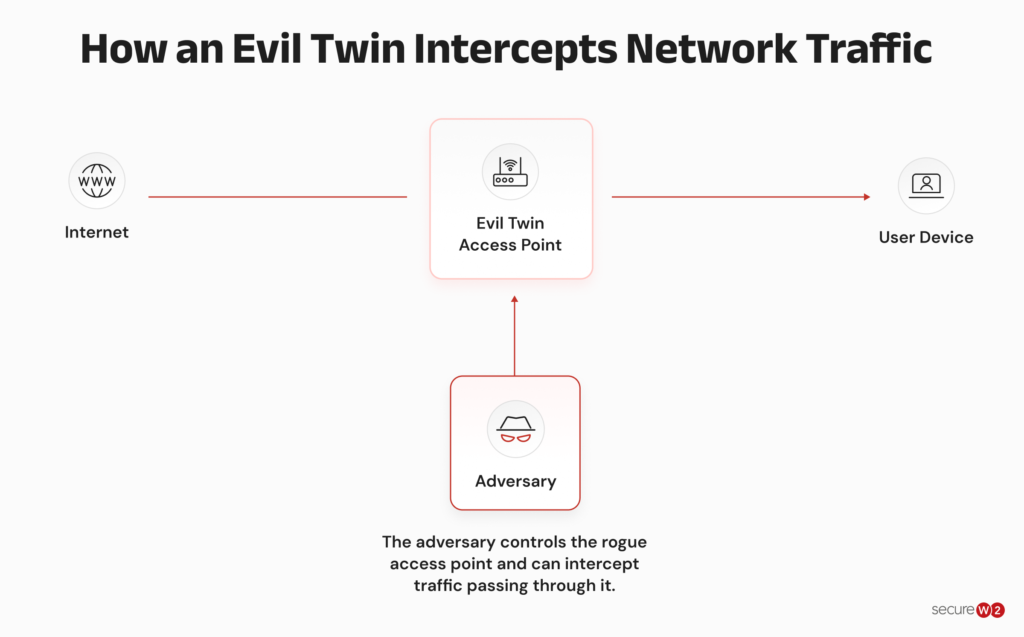
Most consumer devices (and many enterprise ones) will connect to a familiar network name without verifying who controls it.
The Business Impact of Network Eavesdropping
Passive interception is costly because it rarely announces itself.
After capturing traffic over weeks or months, attackers typically walk away with authentication credentials, session tokens and internal application data. Crucially, they do so without a single failed login or blocked connection, either of which could alert a security team.
Because the goal is observation rather than disruption, eavesdropping is frequently the reconnaissance phase that precedes a larger breach, not the breach itself.
Intercepted credentials from a Wi-Fi session or an unencrypted internal service can be used to escalate privileges, move laterally or set up a more damaging active attack later. These are some high-impact areas:
- Credential exposure: Captured usernames, passwords and session tokens provide direct access to other systems.
- Regulatory exposure: Intercepted education, health or financial records can trigger breach-notification obligations regardless of whether the data was ever misused.
- Extended dwell time: Since passive capture leaves no clear trace, attackers can maintain access for weeks before detection.
The security plan that scales with you.
Our solutions can scale from mid-market to global enterprises. Compare options and see how our solutions protect you from costly breaches and ensure peace of mind.
How to Prevent Network Eavesdropping
Conversations about network eavesdropping prevention often revolve around the same practices: encrypting traffic, using a VPN, segmenting the network and training users.
While those controls are important, they don’t address the root cause: a device connecting to a network (or a network accepting a device) without either party first proving their identity.
Here are some additional prevention methods:
Encryption Protects the Payload, Not the Position
Transport Layer Security (TLS) and Media Access Control Security (MACsec) encrypt the contents of traffic. As a result, the passive observer captures ciphertext instead of plaintext.
That is genuine protection. However, it does not stop an attacker from getting into a position to capture the traffic. It does nothing to stop a device from joining a rogue access point that never presents a certificate to inspect, either.
The fix sits one layer beneath encryption, in how the Extensible Authentication Protocol (EAP) negotiates authentication before trusting a connection.
Certificate-Based Authentication With EAP-TLS Closes the Gap
Defined in RFC 5216, the Extensible Authentication Protocol-Transport Layer Security (EAP-TLS) method supports certificate-based mutual authentication: the network proves its identity to the device with a server certificate, and the device proves its identity to the network with a client certificate. This takes place before any traffic passes.
These certificates come from a public key infrastructure (PKI). The PKI is responsible for certificate issuance, validation and revocation.
New to PKI? Get started with our introductory video below.
A device that validates the Remote Authentication Dial-In User Service (RADIUS) server certificate before authenticating will not hand credentials to a rogue access point. That validation has to check two things, not one:
- that the certificate chains to the specific trust anchor the device was configured with
- that the server name in the certificate matches a configured name
A device that trusts any publicly issued certificate and skips the name check is still exposed, because an attacker can simply obtain a certificate the device will accept.
Most eavesdropping guidance skips this next piece: encryption secures the channel, but mutual certificate validation determines whether an attacker can ever occupy it.
IEEE 802.1X Ties Authentication to Network Access
Institute of Electrical and Electronics Engineers (IEEE) 802.1X is the port-based access control standard that enforces this authentication before a device is allowed onto a wired or wireless network, as opposed to trusting the device by default and revoking access later.
The video below explains how 802.1X works in the background:
When combined with EAP-TLS, 802.1X means an attacker cannot join the segment without a valid certificate.
As a second layer, network segmentation with virtual local area networks (VLANs) still matters, but it works best alongside authentication that keeps untrusted devices from ever connecting to the segment in the first place.
Stop Network Eavesdropping With Certificate-Based Access
Reading enterprise traffic should require more than sitting on the same Wi-Fi network or splicing into the same switch port.
The SecureW2 JoinNow Dynamic PKI platform issues and manages the digital certificates that mutual authentication requires, so every device proves its identity before receiving network access.
Paired with JoinNow Cloud RADIUS, authentication decisions happen in real time against your identity provider, without an on-premises RADIUS server to patch, size or maintain.
Ready to take passive interception off the table as an easy attack path on your network?
Schedule a demo to see how certificate-based authentication keeps untrusted devices off the wire in the first place.
Frequently Asked Questions
Is eavesdropping detectable?
Passive interception is difficult to detect directly. In fact, that difficulty is the entire point of the attack. Eavesdropping doesn’t alter, block or drop anything, so there aren’t any failed connections or error messages for a monitoring tool to discover.
Detection usually relies on indirect signals: an unexpected new access point, a switch port suddenly forwarding unicast traffic across an entire broadcast domain or credentials that turn up somewhere they should not.
Authentication that limits who can join a segment reduces how much an attacker can capture even when detection fails.
Does HTTPS make network eavesdropping harmless?
No. HTTPS encrypts the payload of a web session, so a passive observer captures ciphertext instead of readable data. Despite that, plenty of enterprise traffic still runs without it:
- Internal applications
- Legacy protocols
- DNS lookups
- Metadata like which hosts a device is talking to
An attacker positioned on the network can also see connection patterns and timing even when the payload itself is encrypted, and any session that falls back to an unencrypted protocol is fully exposed.
Is a VPN enough to prevent eavesdropping on a corporate network?
A VPN encrypts traffic between a device and a gateway, which stops eavesdropping on that specific path. However, a VPN does not authenticate the network the device joins before the VPN tunnel starts.
A device can still connect to a rogue access point, hand over its wireless credentials, and only then establish the VPN tunnel over an attacker-controlled connection.
VPNs protect data in transit; they do not decide which networks a device is allowed to trust in the first place.
Can attackers eavesdrop on a switched network?
Yes. A properly functioning switch limits traffic to the ports involved in a conversation, but that protection breaks down under a few common conditions. For example, an address table filled to capacity and failing open, a port configured for mirroring or an attacker who has already compromised a device on the segment.
A switched network raises the bar over a shared hub, but it does not make passive interception impossible.
