
























Agentic AI & Machine Identity

Certificate-Based Security for Every Agent and Machine

One phished credential or stolen device can expose everything your AI reaches. SecureW2 Dynamic PKI binds access to verified identity and device posture. Every agent must prove it belongs before touching a data source.

Display Widget Preview

The Standard for Certificate-Based Security

Join the organizations that replaced passwords and shared secrets with cryptographic trust.
Gallery Image
Gallery Image
Gallery Image
Gallery Image
Gallery Image
Gallery Image
Gallery Image
Gallery Image

Before vs After

Protecting AI Access With Passwords Is a Different Kind of Risk

Token-based access creates a flat permission model. Certificate-based identity creates one that reflects your actual policies.

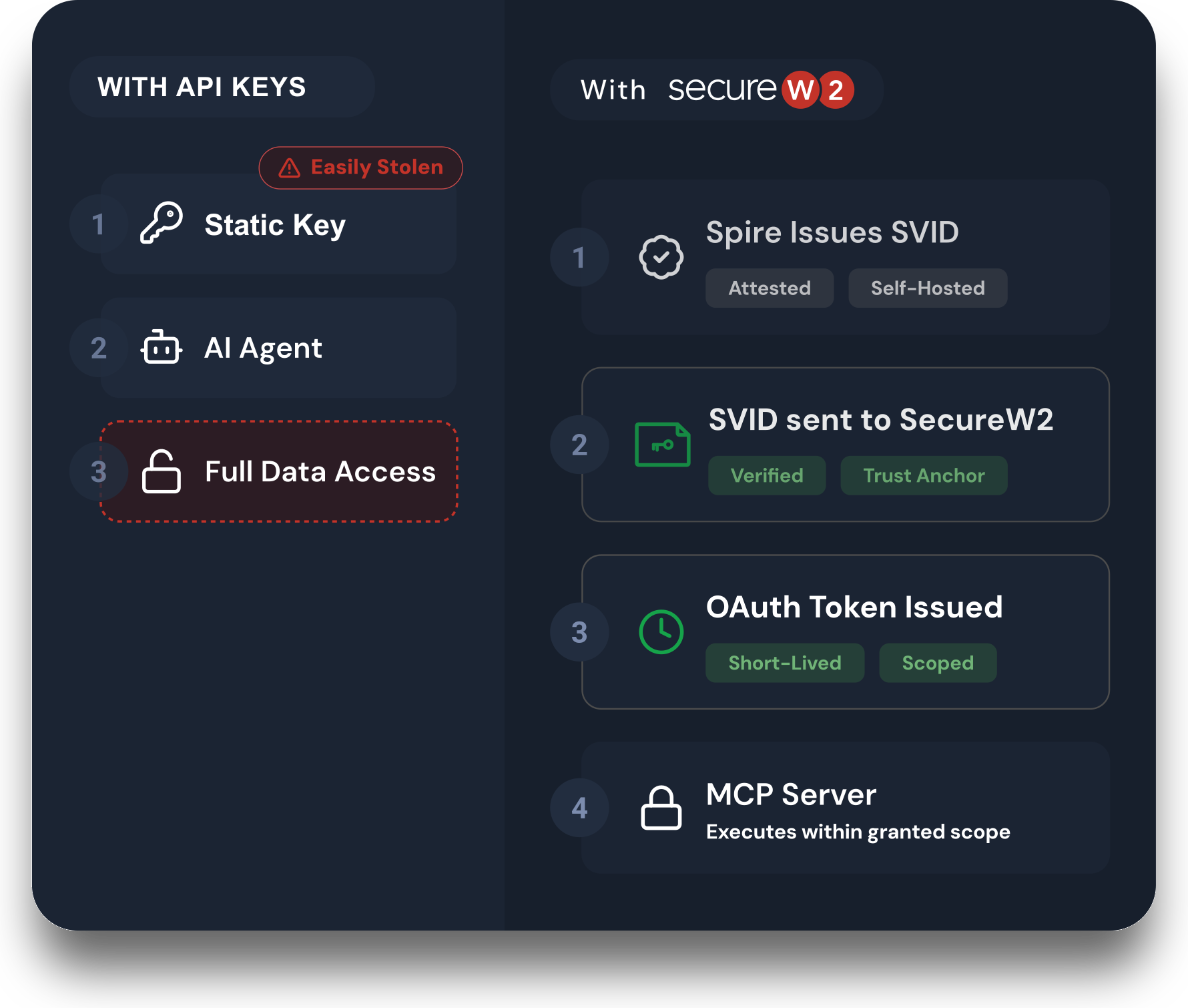
Problem With Passwords & API Tokens
With SecureW2
Credential Theft

Stolen credentials give immediate access to everything your AI can reach.

Certificates are hardware-bound. Stolen passwords are useless without the device.

Device Verification

There's no check on whether the device is corporate-managed or personal.

MDM enrollment and device compliance are validated before a certificate is issued.

BYOD Access

Employees can reach AI systems from personal devices with no way to detect it.

Only managed devices receive certificates. Unmanaged devices are blocked.

Access Scoping

API tokens typically grant broader access than agents need.

IDP groups map to MCP scope automatically. Agents only reach what their role allows.

Policy Sync

Access policies and authentication live in separate systems and drift apart.

IDP policies enforce access at authentication. No manual mapping required.

Credential Theft

Stolen credentials give immediate access to everything your AI can reach.

Certificates are hardware-bound. Stolen passwords are useless without the device.

Device Verification

There's no check on whether the device is corporate-managed or personal.

MDM enrollment and device compliance are validated before a certificate is issued.

BYOD Access

Employees can reach AI systems from personal devices with no way to detect it.

Only managed devices receive certificates. Unmanaged devices are blocked.

Access Scoping

API tokens typically grant broader access than agents need.

IDP groups map to MCP scope automatically. Agents only reach what their role allows.

Policy Sync

Access policies and authentication live in separate systems and drift apart.

IDP policies enforce access at authentication. No manual mapping required.

Passwordless AI Access Control

SecureW2 replaces static credentials and over-scoped API tokens with certificate-based, device-aware authentication. Every AI request can be tied to verified users, managed devices, and enforced identity policies before access is granted.

Ready to Eliminate Machine Identity Risk?

See how certificate-based authentication replaces shared secrets with cryptographic proof your security team can trust.

How It Works

Every Access Request Has to Earn Its Way In

SecureW2 validates identity, device state, and compliance before issuing a certificate. Then that certificate governs exactly which data sources the agent can access.

Phase 1 • Get Into The AI System

User / Device

Requests certificate

Identity Provider

User Status Group
Active Finance Team

MDM

Managed Device Compliance
Yes Pass

EDR

Risk Score Threat Status
Low Clean

SecureW2
Dynamic PKI

Continuous Trust Eval

Certificate Issued

Hardware-bound
Phase 2 • Get To The Data

User / Device

Presents certificate

SPIRE Server

Trust Verified

SVID Issued

To AI Agent • 5-15 min TTL

MCP Server

Policy-scoped access
Finance ERP JIRA ServiceNow ×HR Systems ×Eng Systems
Operational Impact

Faster Rollouts, Fewer Tickets, Stronger Access Control

Teams use SecureW2 to cut support work, accelerate onboarding, and tighten access control across every machine and agent identity.

20%

Fewer support tickets

Customer-reported reduction

99.999%

Uptime SLA

~5 minutes downtime per year (max)

~4 weeks

Time to deploy

Customer-reported (G2)

4 months

Average time to ROI

Customer-reported (G2)

Results vary by deployment. Metrics shown are from customer-reported outcomes and audits.

See Certificate-Based Security in Action

Our security experts can show you exactly how this architecture replaces shared secrets in your environment.

FEATURED USE CASES

Certificate Trust for Your Highest-Risk Workflows

API tokens hardcoded in env files and AI agents running on shared keys are the two fastest paths to a breach. Here's what replacing them looks like.

Give a phished employee 15 minutes at an AI prompt backed by API token auth and they can export your entire finance dataset. Token-based MCP access has no device check, no group policy, and no expiry.

STEP 1

User Request

Finance team user attempts to access Claude. Unmanaged and personal devices are rejected outright.

STEP 2

SPIRE Validation

SPIRE verifies the user's cert against SecureW2 PKI: hardware-bound, device compliant, user confirmed as Finance Team in Okta.

STEP 3

SVID Issued

A 15-minute SVID scoped to Finance MCP context is issued to the AI agent.

STEP 4

Scoped MCP Access

Agent accesses Finance systems. SVID expires after the session

Ready to Implement These Use Cases?

Connect with our team to see how these machine identity patterns work with your existing infrastructure and deployment pipelines.

Designed for Real-Time, Context-Aware Enforcement

Works Seamlessly With the Security Stack You Already Use

SecureW2 ingests real-time signals from your existing tools such as SIEMs, EDRs, firewalls, and identity providers using native integrations, webhooks, and eventhooks. These insights feed our policy engine to deliver precise, context-rich access decisions when and where they matter most.

SecureW2 Logo
SecureW2
Certificate Authority at the Center of Your Security Ecosystem
200+ Integrations
Identity & Access Icon
Identity & Access Policy Enablement & SSO
Okta Logo
Entra ID Logo
Ping Identity Logo
OneLogin Logo
Google Logo
Shibboleth Logo
+ Many More
Device Management Icon
Device Management MDM/EMM & Cert Gateway
Jamf Logo
Microsoft Intune Logo
Workspace ONE Logo
MobileIron Logo
Kandji Logo
Mosyle Logo
+ Many More
Network Security Icon
Network Security SASE & ZTNA
Palo Alto Networks Logo
Cisco Logo
Fortinet Logo
Check Point Logo
Zscaler Logo
Sophos Logo
+ Many More
Wireless Security Icon
Wireless Security 802.1X Wi-Fi Enterprise
Cisco Meraki Logo
Ubiquiti Networks Logo
Fortinet Logo
HPE Aruba Logo
CommScope Logo
Mist Logo
+ Many More
Threat Intelligence Icon
Threat Intelligence EDR/XDR & SIEM Platforms
CrowdStrike Logo
Palo Alto Networks Logo
Microsoft Defender Logo
Splunk Logo
Datadog Logo
Elastic Security Logo
+ Many More
AI & Agentic Security Icon
AI & Agentic Security MCP & Orchestration
Claude Logo
OpenAI Logo
Docker Logo
Kubernetes Logo
SaltStack Logo
Puppet Logo
+ Many More
Certificates For Any Access Surface

If It's Accessible, It's Securable

Discover how our comprehensive identity and access management solutions can secure your organization across different use cases and environments.

/ NETWORK AUTH
/ AGENTIC AI & MACHINE ID
/ SSO & WEB APPS
/ ZTNA/VPN
/ DESKTOP LOGIN
/ GUEST WI-FI
SecureW2 / NETWORK AUTH

Modernize Auth for Wired and Wireless Networks

Fast, reliable 802.1X and Cloud RADIUS authentication for Wi-Fi and wired access—powered by real-time policy evaluation and passwordless certificate-based access that adapts to identity, posture and risk.

Lower IT Overhead

Reduce help desk tickets by 20% with automated enrollment
and renewal

Automate Onboarding

Provision certificates silently via your existing MDM

Control Device Access

Clear visibility into every access event for effortless
compliance

INTEGRATIONS
SecureW2 / AGENTIC AI & MACHINE ID

Identify & Control all Agentic AI Access

Mutual TLS certificates eliminate the risk of API key compromise in agentic AI deployments, binding agents to verified device identities. Works alongside SPIRE servers to issue short-lived SVIDs that scope exactly what each agent can reach across your MCP-connected data sources.

Strengthen AI System Access

Replace shared tokens with certificates that verify the
user/device before access.

Stop Credential Theft

Certificates can't be phished or reused the way stolen
passwords can.

Enforce Data Boundaries

Automatically scope each AI agent to only the data its
role allows.

INTEGRATIONS
SecureW2 / SSO & WEB APPS

Device Trust for SSO and Applications

Dynamically issue x.509 certificates through policies that authorize scoped access based on role, risk and device context. Enforce least-privilege access to SaaS and internal apps from trusted devices only.

Verified Device Access

Only managed, healthy devices reach your SaaS apps

Reduce Authentication Fatigue

Frictionless login that eliminates recurring prompts and
resets

Phishing-Resistant SSO

Certificates that can't be phished or socially engineered

INTEGRATIONS
SecureW2 / ZTNA/VPN

Enforce Least-Privilege Access for Remote Workers

Enable secure distributed access with certificate-based ZTNA and VPN integrations. Dynamic policy decisions authorize access based on real-time signals from your existing security stack.

Enforce Device Trust

Enforce granular, policy-driven access for every remote
session

Strengthen Posture Assessment

Close the gap left by SASE tools that ignore device
compliance

Instant Threat Revocation

Auto-kick compromised devices the second a risk signal is
detected

INTEGRATIONS
SecureW2 / DESKTOP LOGIN

Passwordless Desktop Authentication

Enforce certificate-backed login with YubiKeys, smart cards and other hardware tokens. Dynamic certificate management supports PIN and PUK functionality and automates enrollment, renewal and slot assignment.

Prevent Local Data Breaches

Block attackers from exploiting weak local credentials to
access sensitive data

Secure Lost or Stolen Hardware

Revoke device login certificates the moment a device is
reported missing

Fast Multi-User Access

Secure, rapid user switching on shared devices via smart
cards

INTEGRATIONS
SecureW2 / GUEST WI-FI

Deliver Guest Wi-Fi with Role Limits and Expiration

Provision guest access with minute-level control. Supported methods include sponsor approval and self-registration through Captive Portal, plus directory integration with LDAP, Google, PowerSchool and SAML.

Auto-Expiring Access

Custom durations that revoke automatically—no manual
cleanup

Simple Guest Access

Guests connect via SMS or social login, eliminating
repetitive IT setup

Operational Efficiency

Reduce IT workload by delegating guest approvals to
employee sponsors

INTEGRATIONS

Frequently Asked Questions

Why can't we just use API keys or tokens for AI agent authentication?

Even short-lived OAuth 2.0 tokens carry no signal about the device or identity behind a request, and they can be stolen and replayed before they expire. When an AI agent authenticates with a token, the MCP server just sees a valid credential. It can't tell whether it's running on a managed corporate machine or a threat actor's laptop. This isn't theoretical: in April 2026, attackers compromised a Context.ai employee's machine, exfiltrated OAuth tokens, and pivoted into Vercel's internal systems through an overpermissioned grant to a third-party AI tool. A hardware-bound certificate closes that gap. It's cryptographically tied to a specific machine and backed by real-time signals from your MDM and EDR, so even exfiltrated certificate material won't authenticate without the physical device it was issued to.

What's the difference between the SecureW2 certificate and the SVID from SPIRE? Why are there two?

The SecureW2 certificate is your long-lived identity credential, issued after validating user identity in Okta, device compliance in your MDM, and risk posture in your EDR. The SVID is a short-lived task credential, typically 5-15 minutes, that SPIRE issues at the moment an agent needs to access a specific data source. Think of the certificate as an ID badge and the SVID as a time-limited access pass to a specific room: the badge proves who you are, the pass controls what you can reach right now. The short TTL means there is no persistent credential to exfiltrate between sessions.

What does "hardware-bound" mean, and why does it matter for AI security specifically?

An AI agent doesn't sit at a desk, but it does run on a machine, and that machine is what the certificate binds to. Without hardware binding, anyone who obtains a valid credential can spin up an agent from any device: a personal laptop, a cloud VM, or an attacker-controlled server. Your access controls have no way to distinguish that from a legitimate session. Hardware binding ensures the agent can only execute on a managed, compliant machine enrolled in your MDM, so shadow IT deployments and stolen-credential attacks fail at the same point: if the machine isn't the one the certificate was issued to, access is denied.

What happens if a device is compromised after a certificate has already been issued?

SecureW2's CertIQ engine continuously monitors certificate behavior against real-time signals from your EDR and MDM. If a device's risk score spikes in CrowdStrike or its compliance status changes in Jamf or Intune, the policy engine revokes the certificate immediately via CRL or OCSP and the agent loses access within minutes, not at the next scheduled rotation cycle. You don't need to manually hunt down and rotate every credential that trusted the compromised device.

How does SecureW2 know which data sources a specific AI agent is allowed to access?

Access policy flows from your existing identity infrastructure, so you are not writing new rules from scratch. When a certificate is issued, it encodes the user's Okta group membership. SPIRE reads those attributes and issues an SVID scoped only to the MCP contexts that group is permitted to reach. A Finance Team agent can access Finance ERP, JIRA, and ServiceNow. HR Systems and Engineering are excluded automatically because the Okta group policy says so.

How long does deploying certificate-based auth for an existing agent setup typically take?

For teams already running Okta and an MDM like Jamf or Intune, most deployments reach production in two to four weeks. The bulk of that time is policy configuration, specifically defining which groups can access which MCP contexts, not infrastructure work. SecureW2 issues certificates via REST API, ACME, or SCEP, so agent frameworks that support mTLS require configuration changes rather than code rewrites.

Built for Modern Automation

Eliminate Credential Risk for APIs, Services, and Machines

Secure non-human identities with automated certificate-based authentication. Replace hardcoded secrets and shared service accounts with short-lived X.509 identities integrated with your existing identity and device systems.