Key Points
- A replay attack captures a valid login message and resends it later to gain unauthorized access. These attacks work by capturing a legitimate message in transit, then retransmitting it before the system detects the repeat.
- Attackers replay session tokens, credentials, and even key fob signals across networks, web apps and IoT devices.
- Nonces, timestamps and short-lived tokens help prevent replay attacks by making captured authentication messages unusable. Certificate-based authentication goes a step further by removing reusable shared secrets entirely.
Passwords and session tokens are meant to prove who you are at a single point in time. A replay attack breaks that assumption.
A replay attack is a network security exploit in which an attacker intercepts a valid authentication message and resends it to gain unauthorized access. They don’t need to crack a password or forge anything. They just play it back.
This article covers how replay attacks work, how they differ from man-in-the-middle attacks, real-world examples, and replay attack prevention methods, including certificate-based authentication.
What Is a Replay Attack?
A replay attack occurs when an attacker records a previously sent message between a legitimate user and a system, then resends that same message to impersonate the user without needing to know their actual credentials.
It’s also called a playback attack. The attacker doesn’t need to decrypt or modify the captured data. If a system accepts the same message twice as if it were two separate, valid requests, the replay attack succeeds.
Replay attacks are dangerous because they can succeed even over encrypted channels.
Encryption protects the content of a message from being read, but by itself does not prevent the same encrypted message from being resent again, unless the protocol includes a mechanism to detect repetition.
How Replay Attacks Work
A replay attack follows a simple four-stage process, regardless of whether the target is a Wi-Fi login, a banking session or a wireless key fob. This is depicted in the image below.
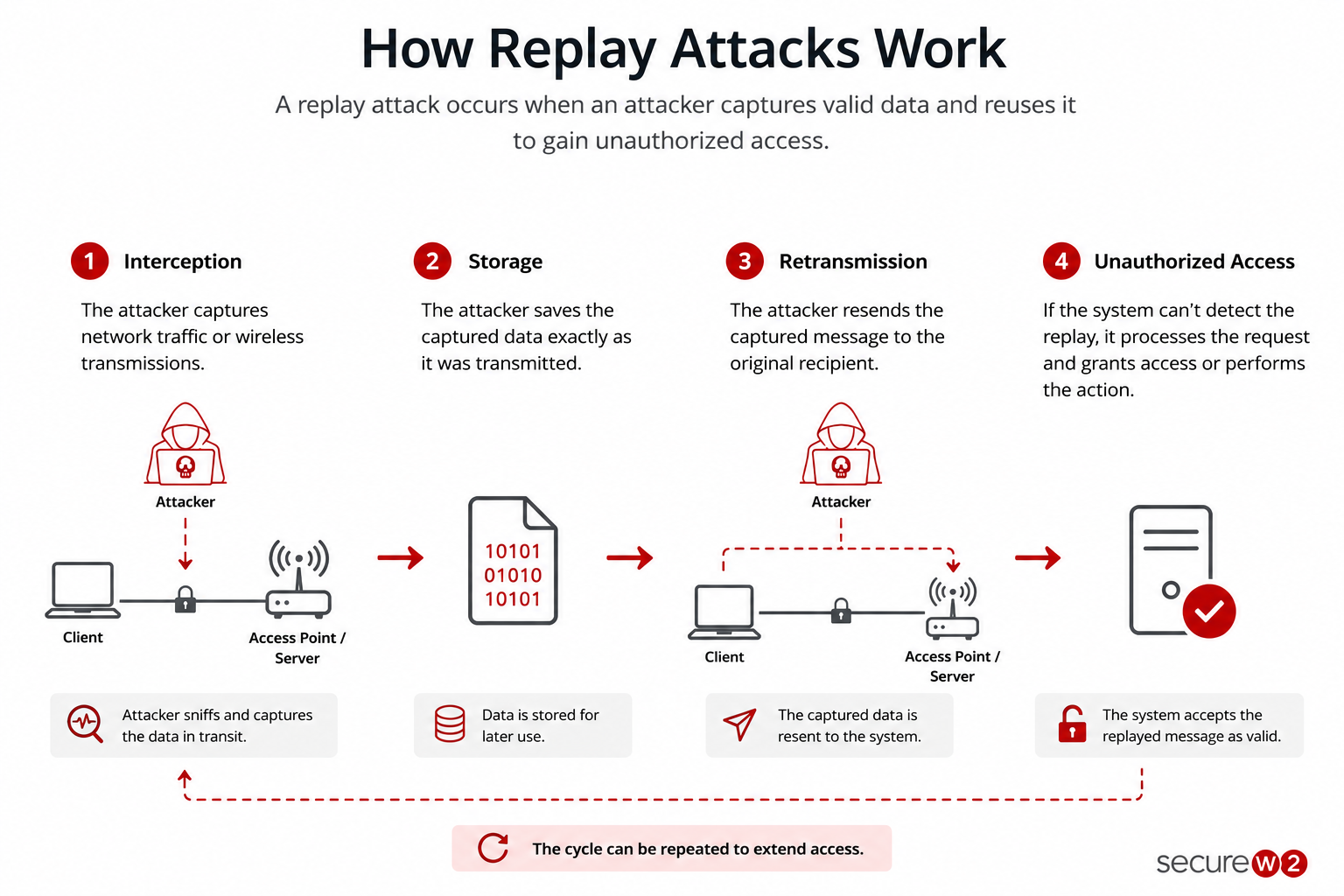
Here are the four steps in detail:
- Interception: The attacker positions themselves to capture network traffic, often through packet sniffing on an unsecured Wi-Fi network or by intercepting a wireless signal like a key fob transmission.
- Storage: The attacker saves the captured data exactly as it was transmitted, without needing to decrypt or understand its contents.
- Retransmission: The attacker resends the captured message to the original recipient, while the credential or session is still considered valid by the target system.
- Unauthorized access: If the receiving system cannot distinguish the replayed message from the original, it processes the request and grants access or executes the action.
The attack depends entirely on the target system’s inability to recognize that a message has already been used. Protocols that use one-time values, such as nonces or sequence numbers, can detect and reject replayed messages before they are accepted.
What Are the Types of Replay Attacks?
Replay attacks show up across several layers of authentication and communication, each with a slightly different target. Common examples include:
- Session replay attack: An attacker captures a session token or cookie and reuses it to hijack an active or still-valid session without logging in again.
- Credential replay attack: An attacker captures a raw authentication exchange, such as a hashed password sent over a weak protocol, and resends it to authenticate as the original user.
- Transaction replay attack: An attacker resends a captured financial or data transaction message, causing the action to be executed a second time, such as issuing a duplicate funds transfer.
- Command replay attack: An attacker captures a control signal, common in the Internet of Things (IoT) and wireless devices, and replays it to trigger the same action again, such as unlocking a car door or opening a garage.
MITRE documents message replay as a common attack technique against embedded and IoT devices that lack protections such as nonces or timestamps. This allows attackers to trigger unauthorized actions by simply retransmitting previously captured messages.
Replay Attack vs. Man-in-the-Middle Attack
Replay attacks and man-in-the-middle (MITM) attacks both rely on intercepting network traffic, so they’re often confused. One of the differences is what the attacker does with the intercepted data.
In a replay attack, the attacker captures a legitimate message and resends it unchanged at a later time. The attacker doesn’t need to read, decrypt or alter the message; the resend itself is the attack.
In a MITM attack, the attacker positions themselves between two parties in real time, often altering, injecting or relaying messages to eavesdrop or manipulate the exchange as it happens.
The table below highlights the key differences between replay attacks and MITM attacks.
| Factor | Replay Attack | Man-in-the-Middle Attack |
| Timing | Delayed; message is reused later | Real time; attacker is active during the exchange |
| Data Handling | Message is stored and resent unchanged | Data may be read, altered or injected |
| Attacker Position | Doesn’t need to stay in the communication path | Must remain positioned between both parties |
| Primary Defense | Nonces, timestamps, one-time tokens | Mutual authentication, certificate validation |
A replay attack can also be a component of a broader MITM campaign. An attacker in a MITM position is well placed to capture messages for later replay, but the two techniques defend against different weaknesses.
Real-World Examples of Replay Attacks
Replay attacks have been demonstrated against consumer hardware, network authentication protocols and financial systems. The following examples show how replayed messages can be used to gain unauthorized access or repeat legitimate actions:
- Key fob rolljam attacks: Security researchers demonstrated an attack against rolling-code key fobs where the attacker jams and records a car’s unlock signal, blocks it from reaching the vehicle, then replays the previously captured code later to unlock the car at will.
- Session hijacking on unsecured Wi-Fi: An attacker on the same open network captures a session cookie in transit and replays it to a web application, taking over an authenticated session without ever seeing the user’s password.
- Weak authentication protocol exploitation: Legacy authentication methods that transmit static, reusable credential hashes over the wire give an attacker everything needed to replay that exchange later, since the hash itself doesn’t change between login attempts.
| See your security gap before attackers do. |
| Get a live walkthrough of the SecureW2 JoinNow Platform to see how we keep networks protected with secure certificates. |
| Schedule a Demo → |
How to Prevent a Replay Attack?
Replay attack prevention focuses on making every authentication message unique, so a captured copy becomes worthless. Common replay attack defenses include the following:
- Nonces and timestamps: A nonce is a random, single-use value included in each authentication exchange. The receiving system rejects any message it has already seen with that value. The National Institute of Standards and Technology’s (NIST’s) guidance on authenticator freshness requires that a nonce derived from a real-time clock be rotated at least once every two minutes to limit the window an attacker has to replay it.
- Session tokens with short expiry: Limiting how long a session token remains valid shrinks the window during which a captured token can be reused.
- Sequence numbers: Some protocols attach an incrementing counter to each message, allowing the receiver to detect and discard messages that repeat or arrive out of order.
- Mutual authentication and encrypted channels: Requiring both sides of a connection to verify each other’s identity, combined with strong encryption, limits an attacker’s ability to capture usable data in the first place.
- Monitoring and anomaly detection: Logging authentication attempts and flagging duplicate or out-of-sequence requests helps catch replay attempts that slip past a single control.
None of these controls work in isolation. A short-lived token with no nonce can still be replayed within its valid window, while a nonce with no encryption can be captured before it’s used. Layered controls close more of the gap than any single fix.
Preventing Replay Attacks in 802.1X and Certificate-Based Authentication
Network authentication protocols carry the same replay risk as any other credential exchange, and 802.1X networks that still rely on password-based methods like PEAP-MSCHAPv2 inherit that exposure.
The Extensible Authentication Protocol (EAP) method EAP-TLS closes it differently.
EAP-TLS builds authentication on Transport Layer Security (TLS), so the client and server verify each other’s identity through mutual certificate validation before any session begins. How EAP-TLS works is shown in the image below.
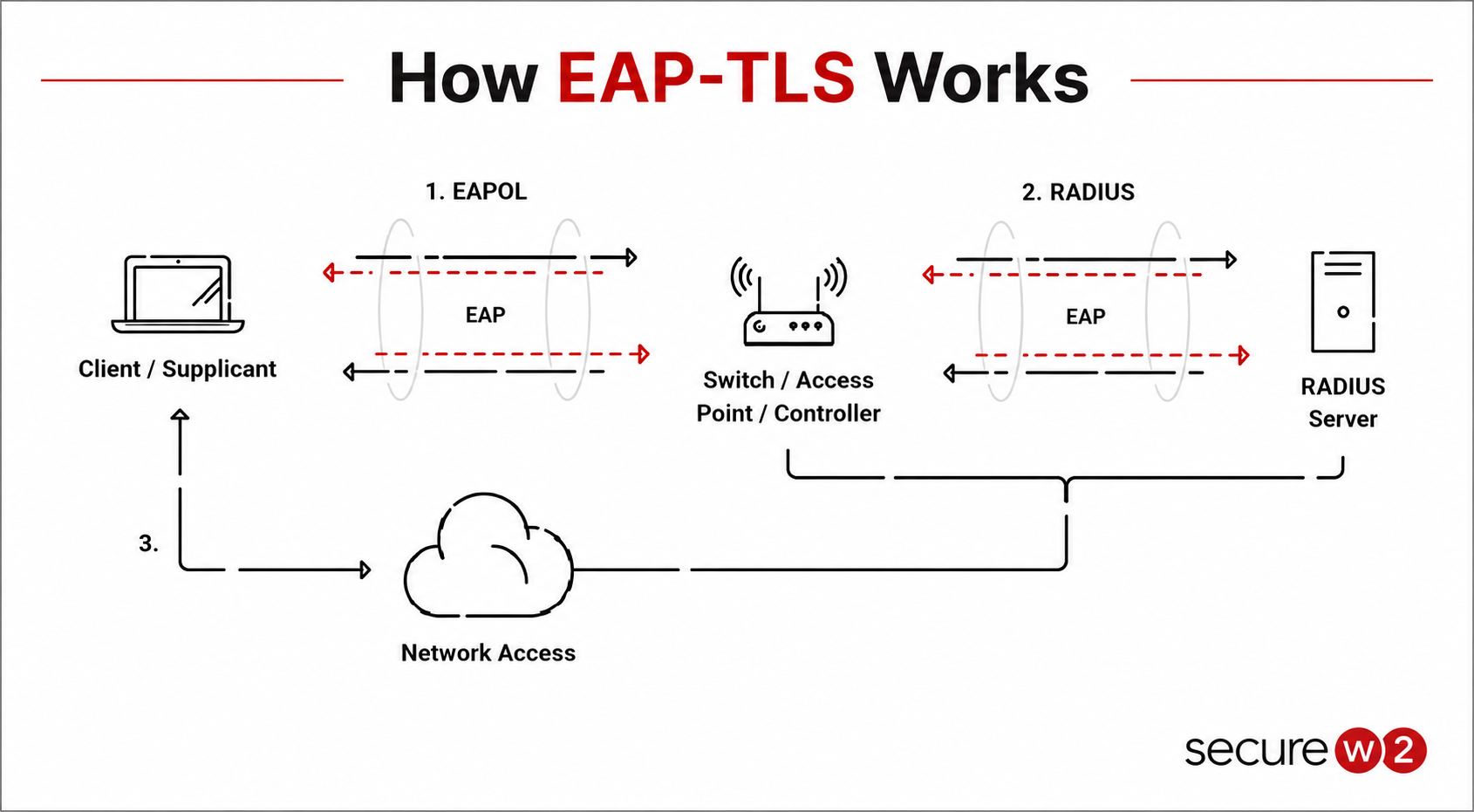
The protocol’s design carries formal replay protection and per-session key derivation as core security properties.
The practical effect: even if an attacker captures a full EAP-TLS exchange, the session keys generated during that handshake are unique to that one connection.
There’s no static, reusable secret to intercept and replay, because a certificate authenticates identity through cryptographic proof of possession rather than a shared value transmitted over the wire. This is the core advantage of moving 802.1X authentication away from credential-based methods.
The SecureW2 JoinNow Dynamic PKI issues non-exportable digital certificates for network authentication, so there’s no password hash or shared secret sitting on the wire for an attacker to capture in the first place.
Paired with JoinNow Cloud RADIUS, every authentication request is validated against the identity provider in real time, using per-session cryptographic material instead of a static credential that could be captured and replayed later.
Stop Replay Attacks at the Authentication Layer
Nonces and timestamps reduce the replay window, but certificate-based authentication removes the target altogether. If there’s no reusable password or shared secret moving across the network, there’s nothing for an attacker to capture and resend.
The SecureW2 Dynamic PKI and Cloud RADIUS work together to replace credential-based Wi-Fi, VPN and application authentication with certificates bound to a specific user and device.
Eliminate unauthorized access with industry-leading reliability and deployment options that support up to 99.999% availability.
Schedule a demo to see how certificate-based authentication closes the replay attack window across your network.
Frequently Asked Questions
What is a replay attack?
A replay attack is a cybersecurity attack where an attacker intercepts a valid data transmission, such as an authentication message, and resends it later to trick a system into granting unauthorized access, without needing to know the actual credentials involved.
How do replay attacks work?
An attacker captures a legitimate message in transit, stores it without needing to decrypt it, then retransmits it to the original recipient while the credential or session is still considered valid. If the receiving system can’t distinguish the replay from the original message, it processes the request as legitimate.
What is the difference between a replay attack and a man-in-the-middle attack?
A replay attack captures a message and resends it unchanged at a later time, without needing to remain in the communication path. A man-in-the-middle attack requires the attacker to stay actively positioned between both parties in real time, often reading or altering the traffic as it passes through.
What are examples of replay attacks?
Common examples include rolljam attacks against rolling-code key fobs, session hijacking through captured cookies on unsecured Wi-Fi, and exploitation of legacy authentication protocols that transmit static, reusable credential hashes.
How can replay attacks be prevented?
The standard defenses are nonces, timestamps and short-lived session tokens that make each authentication exchange unique. Certificate-based authentication protocols like EAP-TLS go further by deriving unique per-session keys through mutual certificate validation, so there’s no static shared secret available to capture and replay.
