Key Takeaways
- WPA3 strengthens authentication by replacing WPA2-PSK with SAE, eliminating offline dictionary attacks through per-session key exchange and providing forward secrecy against captured handshakes.
- WPA3-Enterprise enforces mandatory server certificate validation and supports optional 192-bit CNSA cryptographic suites, significantly reducing credential theft and strengthening high-security deployments.
- WPA3 introduces a structured security upgrade path for enterprise environments, but adoption is constrained by IoT and legacy device incompatibility, making WPA2/WPA3 transition modes operationally necessary in mixed networks
Wi-Fi Protected Access (WPA) has evolved significantly since its inception in 1999. WPA2 replaced the original standard in 2004 and for years remained the benchmark for secure wireless networks, only recently being supplanted by WPA3. While WPA2 with 802.1X authentication remains highly effective against a wide range of attacks, organizations are increasingly making the switch to WPA3.
WPA3 is still fairly new and typically only used by organizations operating highly sensitive environments such as governments and large corporations. But as more devices and infrastructure are built to accommodate WPA3, it will become more commonly used by smaller organizations as well.
This guide tells you everything you need to know about WPA3-SAE and WPA3-Enterprise, key improvements of WPA3 compared to WPA2, and what organizations can do to optimize their network security whether they use WPA2-Enterprise or WPA3-Enterprise.
What Is WPA3?
WPA3 (Wi-Fi Protected Access 3) is the third generation of the WPA wireless security certification standard. It was developed by the Wi-Fi Alliance to address known vulnerabilities in WPA2 — particularly weaknesses in pre-shared key (PSK) authentication and server certificate validation (SCV).
Major advances of WPA3 over WPA2 include:
- Improved encryption: WPA3 supports the use of Advanced Encryption Standard (AES) in Galois/Counter Mode (GCM), which is more secure than the CCMP (Counter Mode with Cipher Block Chaining Message Authentication Code Protocol) AES encryption used by WPA2. CCMP is still supported by WPA3.
- Simultaneous Authentication of Equals (SAE): Used for personal networks, the SAE protocol, also known as the Dragonfly handshake, improves on the PSK method used in WPA2.
- Enhanced open security mode: Using Opportunistic Wireless Encryption (OWE), WPA3 automatically encrypts information passed via public networks, protecting against passive eavesdropping.
- Mandates SCV for enterprise networks: Authentication servers must be validated in WPA3-Enterprise, meaning there’s no opportunity for hackers to carry out attacks using rogue networks.
- 192-bit cryptography support: Added through the Commercial National Security Algorithms (CNSA) suite, this offers an exceedingly secure form of cryptography. 128-bit cryptography is also still supported in WPA3.
WPA3 certification became available in 2018 and has been required on all Wi-Fi CERTIFIED devices since July 2020.
WPA3 was designed to fix specific, well-documented problems in WPA2. Understanding those weaknesses explains why each WPA3 feature exists.
WPA2 Shortcomings
The main shortcoming of WPA2 is its reliance on pre-shared keys. But WPA2’s weaknesses go beyond password strength — several structural issues limit its security:
- Offline dictionary attacks: Attackers capture a handshake once and guess passwords indefinitely without alerting the network, so weak passwords eventually fail.
- No forward secrecy: A single compromised key can decrypt previously captured traffic, not just future sessions.
- Human error with complex passwords: Long, complex PSKs required for security are also easy to forget or mistype, which pushes users to write them down or reuse them elsewhere.
- Optional server certificate validation: WPA2-Enterprise never required SCV, so misconfigured devices could connect to rogue servers and leak credentials.
WPA3 addresses each of these weaknesses through a redesigned connection process.
How WPA3 Works
WPA3 secures a connection through two linked handshakes instead of the single PSK exchange WPA2 uses. The image below shows what happens between a device and access point, in order:
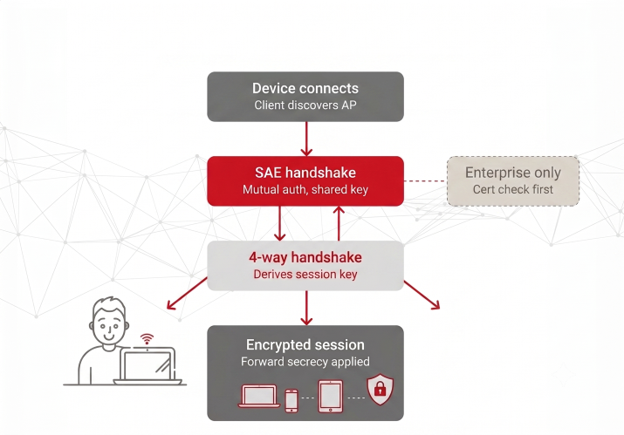
- Device connects: The client discovers the access point and requests to join, just like any Wi-Fi connection.
- SAE handshake runs first: Using SAE, the device and AP each prove they know the password without ever sending it over the air, then derive a shared pairwise master key (PMK).
- WPA3-Enterprise adds a step here: Before SAE, the device validates the Remote Authentication Dial-In User Service (RADIUS) server’s certificate, closing the credential-theft risk that came from skipping server certificate validation on WPA2.
- 4-way handshake follows: The PMK is used to derive a fresh pairwise transient key (PTK) for that specific session, confirming both sides hold the same key without ever exposing it over the air.
Because each connection generates its own unique key, a captured key from one session can’t be reused to decrypt another. This is what gives WPA3 forward secrecy.
WPA3 vs. WPA2: Key Differences
WPA3 improves on WPA2 across both of its main modes — WPA2-PSK and WPA2-Enterprise — though the scope of change differs significantly between them.
WPA3-SAE (Simultaneous Authentication of Equals) vs. WPA2-PSK
WPA3-SAE replaces WPA2-PSK with an SAE handshake. At its core, SAE requires a live exchange with the access point every time a user enters credentials. This small addition is an effective technical control against dictionary attacks.
When an attacker executes a dictionary attack, they capture the handshake, which is public, and then perform an offline attack by instantaneously sending countless software-generated credentials in the hope that one is correct and grants access. WPA3-SAE removes the offline option since it establishes a unique key each time the user and server interact.
By requiring a new, unique key with each attempt, an attacker can only make one dictionary attack guess at a time, rendering the attack useless.
Another WPA2-PSK issue that WPA3-SAE addresses is eliminating vulnerable legacy protocols. Networking is a combination of countless tools, software, and protocols working together. While each component has a specific task, they work in conjunction towards specific goals; in this case, that goal is protecting the network.
Explore the differences between WPA2 and WPA3 in more detail in this video from SecureW2:
WPA3-Enterprise vs. WPA2-Enterprise
There are far fewer improvements for WPA3-Enterprise because WPA2-Enterprise is still a secure method. WPA3-Enterprise does add the optional use of 192-bit key security, increasing the complexity of keys used, which adds even greater security.
But the largest improvement WPA3-Enterprise offers is the requirement for server certificate validation when a cloud RADIUS server is used.
“Configuring Server certificate validation on devices forces them to validate the RADIUS server identity before sending any credentials. If you’re not doing SCV, your device could send its credentials or certificate to any threat actor broadcasting the SSID that you use at work. By mandating devices use SCV, you are greatly reducing the risk of over-the-air credential theft.”
Micah Spady, Director of Product Marketing, SecureW2
In the past, organizations sometimes skipped SCV or lacked onboarding tools, which led to users misconfiguring their devices. WPA3-Enterprise addresses this risk by enforcing SCV, since without it, users are highly vulnerable to over-the-air credential theft.
WPA3 and Wi-Fi Enhanced Open
Enhanced Open addresses a case the other modes don’t: open, password-free networks. While not formally part of the WPA3 certification, it launched alongside WPA3 and is treated as its complement — WPA3 secures password-protected networks, Enhanced Open secures the open ones.
Enhanced Open provides Opportunistic Wireless Encryption (OWE), which is essentially an encrypted open network. Enhanced Open is an improvement upon public venues that use WPA2-PSK, such as coffee shops, bars, or other public places with Wi-Fi. Many hackers have taken advantage of open networks to eavesdrop on others’ connections and steal personal data.
With OWE, users won’t notice any changes — they connect to the open Wi-Fi, accept the rules, and gain Wi-Fi access. Underneath the surface, OWE uses the Diffie-Hellman key exchange, a unique key that is only known by the connecting client and the access point (AP). Since no other party knows the key, eavesdropping on the connection becomes significantly more difficult.
Forward Secrecy in WPA3: Protecting Past and Future Sessions
One of the most significant security advancements in WPA3 is perfect forward secrecy (PFS), a feature largely absent in WPA2-Personal networks. Forward secrecy ensures that even if a long-term secret (such as the network password) is compromised in the future, attackers cannot decrypt previously recorded Wi-Fi sessions.
In WPA2-PSK, the four-way handshake derives encryption keys directly from the pre-shared key. If an attacker captures the handshake and later obtains the password, they can retroactively decrypt all past traffic from that network. This poses a serious risk for organizations that record traffic or face advanced persistent threats.
WPA3-SAE solves this vulnerability by incorporating ephemeral (temporary) key material into every session. A couple of things happen during the handshake:
- The client and access point perform a mutual authentication using password-derived elements combined with fresh random values.
- Unique session keys are generated for each connection attempt.
This design means that passwords compromised later do not reveal past session keys. Each session remains independently secure.
While WPA3-Enterprise with certificate-based authentication (EAP-TLS) already provides strong session security, the addition of forward secrecy in Personal mode makes WPA3 a major leap forward for smaller networks and guest access as well.
WPA3-Enterprise vs. WPA2-Enterprise
There are far fewer improvements for WPA3-Enterprise because WPA2-Enterprise is still a secure method. WPA3-Enterprise does add the optional use of 192-bit key security, increasing the complexity of keys used, which adds even greater security.
But the largest improvement WPA3-Enterprise offers is the requirement for server certificate validation when a cloud RADIUS server is used.
“Configuring Server Certificate Validation on devices forces them to validate the RADIUS server identity before sending any credentials. If you’re not doing SCV, your device could send its credentials or certificate to any threat actor broadcasting the SSID that you use at work. By mandating devices use SCV, you are greatly reducing the risk of over-the-air credential theft.”
Micah Spady, Director of Product Marketing, SecureW2
In the past, organizations sometimes skipped SCV or lacked onboarding tools, which led to users misconfiguring their devices. WPA3-Enterprise addresses this risk by enforcing SCV, since without it, users are highly vulnerable to over-the-air credential theft.
WPA3 and 802.1X Authentication
WPA3-Enterprise with 802.1X allows admins to choose how they will authenticate network users — either with digital certificates or user credentials. Additionally, new 802.1X upgrades in WPA3-Enterprise improve authentication security, including:
- Mandatory server certificate validation
- 192-bit security mode (CNSA)
- Mandates the use of Protected Management Frames (PMF) to prevent deauthentication attacks
- Improved overall session security
Certificates can be configured to do many different things, but a key component is how they are used for network security. Once a user has a valid certificate, they are automatically reconnected to the secure network every time. The user never has to enter a password to reconnect, and the certificate cannot be stolen by an outside attacker.
If you’d like to learn more about the numerous benefits of certificates, read our overview of certificate-based authentication
WPA3 vs WPA2: Side-by-Side Comparison
| Feature | WPA2 | WPA3 |
| Personal Mode | WPA2-PSK (Pre-Shared Key) | WPA3-SAE (Simultaneous Authentication of Equals / Dragonfly) |
| Enterprise Mode | WPA2-Enterprise (802.1X) | WPA3-Enterprise (802.1X) |
| Offline Dictionary Attacks | Vulnerable | Resistant (interactive handshake) |
| Forward Secrecy | Not provided in Personal mode | Yes (built into SAE) |
| Server Certificate Validation | Optional / Often disabled | Mandatory (especially with cloud RADIUS) |
| Encryption Strength | AES-128 (CCMP) | AES-128/256 (GCMP), optional 192-bit CNSA suite |
| Protected Management Frames (PMF) | Optional | Mandatory |
| 192-bit Security (CNSA) | Not supported | Optional (Enterprise) |
| Deauthentication Attacks | Vulnerable | Much more resistant (PMF) |
| IoT / Legacy Device Support | Excellent | Limited (many older devices unsupported) |
| Performance / Latency | Baseline | Minimal impact on modern hardware; slight overhead on legacy devices |
| Best Use Case | Most general networks, legacy devices | High-security environments, new deployments |
See your security gap before attackers do.
See continuous trust in action on a platform that includes RADIUS, PKI and AI security.
WPA3 Adoption and Device Compatibility
Organizations are beginning to offer WPA3 as they refresh access points and as end-user devices gain WPA3 support. The transition timeline varies significantly by organization size, device refresh cycles, and Internet of Things (IoT) device density.
All major wireless solution providers support WPA3, both in their latest products and in their software releases. But WPA3 compatibility is still limited on end devices, especially at the hardware level.
IoT devices present one of the most significant adoption challenges for WPA3. Many IoT devices have fixed firmware and cannot be updated to support WPA3, meaning organizations with large IoT deployments will need to maintain WPA2 compatibility for the foreseeable future.
Note: Since these devices can last for years, the transition to WPA3-exclusive infrastructure will take considerable time, and both WPA2 and WPA3 devices will need to be supported on the same networks during a long transition period.
WPA3 transition mode — a mixed-mode configuration supported by most modern access points — allows WPA2 and WPA3 devices to coexist on the same network while newer devices take advantage of WPA3 security improvements.
Wi-Fi 6 and Wi-Fi 7: Required WPA3 Certification
WPA3 is required for Wi-Fi CERTIFIED 6 (Wi-Fi 6) and Wi-Fi 7 devices, which means adoption will accelerate naturally as organizations upgrade to newer Wi-Fi generations. Wi-Fi 6 introduced WPA3 as a mandatory certification requirement, effectively coupling the WPA3 transition with hardware refresh cycles in enterprise environments.
Benefits of WPA3
At its core, WPA3 comes down to stronger authentication and encryption built directly into the Wi-Fi standard. Here’s what that translates to in practice:
- Stronger password protection: SAE replaces PSK and blocks offline dictionary attacks, so a captured handshake can’t be cracked offline the way it can with WPA2.
- Forward secrecy: Each session uses a unique encryption key, so a compromised key never exposes previously recorded traffic.
- Mandatory server certificate validation (Enterprise): WPA3-Enterprise removes the option to skip SCV, closing a common misconfiguration that led to credential theft.
- Higher-grade encryption for sensitive environments: Optional 192-bit CNSA security gives government and defense networks a cryptographic suite matched to their risk level.
- Safer public Wi-Fi: Wi-Fi Enhanced Open encrypts open networks with OWE, protecting users on coffee shop and airport Wi-Fi without requiring a password.
- Built for future certification: A WPA3 connection is required for Wi-Fi 6 and Wi-Fi 7, so upgrading now avoids a second migration later.
WPA3 Weaknesses and Limitations
WPA3 is a meaningful step forward in wireless security, but it is not without limitations. Understanding these gaps is important for organizations evaluating WPA3 adoption.
- Dragonblood vulnerabilities: Researchers identified side-channel and denial-of-service flaws, known as “Dragonblood,” in the SAE handshake shortly after WPA3’s release. Patches have been issued, but the discovery highlighted that WPA3 is not immune to implementation flaws.
- Transition mode risk: WPA3 transition mode, which allows WPA2 and WPA3 clients to coexist, reduces some of the security benefits of WPA3. An attacker may force a WPA3-capable device to downgrade to WPA2.
- IoT and legacy incompatibility: Many IoT and legacy devices do not support WPA3, limiting the feasibility of enforcing WPA3-only environments.
- Implementation complexity: Advanced modes, such as Commercial National Security Algorithm (CNSA) and 192-bit security, increase configuration complexity and raise the risk of misconfiguration.
The Migration From WPA2 to WPA3
Moving from WPA2 to WPA3 isn’t a single switch flip. It’s a phased rollout that has to account for existing infrastructure, IoT devices, and certificate readiness.
Here’s the practical path:
- Audit your current environment. Inventory access points, client devices, and IoT hardware to identify what already supports WPA3 and what will need WPA2 fallback.
- Enable WPA3 transition mode. Most modern access points support a mixed mode that broadcasts both WPA2 and WPA3, so compatible devices upgrade automatically while older devices stay connected.
- Update RADIUS and certificate infrastructure. WPA3-Enterprise relies on EAP methods that validate the RADIUS server’s certificate, so confirm your server presents a valid, trusted certificate and that onboarding tools push the correct trusted roots to devices.
- Pilot before full deployment. Roll WPA3 out to a small device group across operating systems (Windows, macOS, iOS, Android) to catch driver or firmware gaps before a network-wide switch.
- Segment IoT and legacy devices. Place hardware that can’t support WPA3 on a separate SSID or VLAN so it doesn’t keep the whole network stuck in transition mode.
- Align with Wi-Fi 6/7 refresh cycles. WPA3 is mandatory for devices operating in the 6 GHz band (Wi-Fi 6E and Wi-Fi 7), so timing your migration with hardware refreshes reduces cost and disruption.
- Set a target to retire transition mode. Track which devices remain on WPA2 and set a date to disable mixed mode once legacy and IoT hardware are replaced.
Challenges of Using Digital Certificates With WPA3-Enterprise
Implementing digital certificates used to be difficult and expensive, but managed public key infrastructure (PKI) services have simplified certificate management for organizations of all sizes.
PKIs are cheaper to build now than they were a decade ago, and cloud-based options are more affordable and versatile than on-prem options.
Server Certificate Validation
Server certificate validation is required with WPA3-Enterprise. This may seem troubling to many network administrators, but it’s actually a good thing.
In the past, many organizations instructed their users to use the “Do not validate” setting as a workaround to avoid implementing proper Extensible Authentication Protocol (EAP) SCV. However, not validating can put users at risk of leaking their credentials.
Organizations have two ways to approach SCV: hire trained IT staff to configure end-user devices or deploy a device onboarding service with SCV built in.
Enrolling Devices With Certificates
Managed devices can be easy to configure and enroll with certificates, but the same can’t be said for bring-your-own-device (BYOD) environments because they typically involve the end user. Plus, BYOD policies must cover numerous operating systems (iOS, macOS, Windows, Android), each with its own configuration methods.
Using onboarding software allows IT teams to push a customizable configuration client with an intuitive self-enrollment wizard that guides the end user through the confusion of configuring their device. End users can easily self-onboard, and after clicking a few buttons, their device is configured for 802.1X and enrolled with a certificate.
These certificates can be used to authenticate users for Wi-Fi, remote workers for VPN, and much more.
The security plan that scales with you.
Our solutions can scale from mid-market to global enterprises. Compare options and see how our solutions protect you from costly breaches and ensure peace of mind.
Is WPA2-Enterprise Still a Good Option?
While WPA3 networks are becoming more necessary, WPA2 with 802.1X authentication continues to offer sufficient security for most. However, those who want a highly secure network will certainly benefit from WPA3. The improvements within WPA3 address many of the specific vulnerabilities that have plagued WPA2 in recent years.
If you decide switching to WPA3 is the best choice for your organization, be sure to test all devices and access points before making the switch. A managed PKI provider can help ease the transition if you’re not already using certificates.
Use transition mode if necessary, and continue monitoring endpoints until all have been switched to WPA3. Once the transition is complete, you can switch to WPA3 alone.
See how a top Australian university switched to WPA2-Enterprise, in the process giving them an automated solution for BYOD onboarding.
Secure Your Wireless Network With WPA2 or WPA3 Authentication
Both WPA2-Enterprise and WPA3-Enterprise with certificate-based authentication close the gaps left permanently open by pre-shared keys.
There are no shared secrets to rotate, no credentials exposed to phishing, and no opportunity for rogue devices to bypass a misconfigured RADIUS policy.
Whether your organization uses WPA2 or WPA3, our JoinNow platform enforces EAP-TLS across your wired and wireless infrastructure, connects RADIUS policy to live IdP and MDM data, and revokes access in seconds when a user offboards.
See how SecureW2 secures wireless networks without passwords when you schedule a demo today.
Frequently Asked Questions
What is the difference between WPA2 and WPA3?
WPA3 improves on WPA2 primarily by replacing PSK with Simultaneous Authentication of Equals, which eliminates offline dictionary attacks. WPA3-Enterprise adds mandatory server certificate validation and optional 192-bit security through CNSA. WPA2 remains widely used and is still considered secure, particularly in WPA2-Enterprise configurations with certificates.
Is WPA3 better and more secure than WPA2?
Yes, in nearly every practical sense. SAE eliminates the offline dictionary attack vulnerability of WPA2-PSK, forward secrecy prevents a compromised key from exposing past sessions, and mandatory server certificate validation in WPA3-Enterprise closes a common configuration gap. That said, WPA2-Enterprise with properly configured 802.1X and certificate-based authentication remains highly effective for most organizations. The main trade-off is device compatibility, since older hardware may not support WPA3 yet.
Does WPA3 work with older devices?
WPA3 is not backward-compatible at the protocol level, but most modern access points support WPA3 transition mode, which allows WPA2 and WPA3 devices to connect to the same network simultaneously. Older devices — particularly IoT hardware — may require WPA2 indefinitely or until hardware is replaced.
What is SAE in WPA3?
Simultaneous Authentication of Equals is the authentication mechanism WPA3 uses to replace WPA2’s pre-shared key. SAE requires a unique key exchange for each connection attempt, preventing attackers from running offline dictionary attacks against captured handshake data. SAE also provides forward secrecy, protecting previously recorded traffic even if a key is later compromised.
When is WPA3 required?
WPA3 has been required for all Wi-Fi CERTIFIED devices since 2020, per Wi-Fi Alliance mandates. Devices certified for Wi-Fi 6 (802.11ax) and Wi-Fi 7 must support WPA3. Government and defense environments that follow NSA CNSA guidelines may require WPA3-Enterprise with 192-bit mode.
Does WPA3 make Wi-Fi slower?
For most modern devices and access points (especially Wi-Fi 6 and Wi-Fi 7 hardware), the performance difference between WPA3 and WPA2 is minimal to unnoticeable. The stronger encryption and SAE handshake add a small amount of computational overhead during initial connection, but this has negligible impact on throughput or latency, since the encryption and authentication changes happen during the handshake, not during data transfer. Older or low-power devices — such as some IoT hardware — may see slight increases in latency, and mixed WPA2/WPA3 transition mode can cause more noticeable slowdowns on certain clients due to compatibility handling.
Will my devices work with WPA3?
Most devices made after 2019 support WPA3, since it became mandatory for Wi-Fi CERTIFIED devices in 2020 and is required for Wi-Fi 6 and Wi-Fi 7 certification. Older phones, laptops, and especially IoT devices like printers or smart plugs may only support WPA2. Check your device's Wi-Fi settings or manufacturer specs to confirm, and use WPA3 transition mode on your router so older devices stay connected while newer ones use WPA3.
What Is CNSA?
Commercial National Security Algorithms (CNSA) is a set of cryptographic algorithms developed by the NSA to protect government information and is now a new 802.1X configuration option introduced with WPA3. CNSA requires specific algorithms that all have about the same level of security. This eliminates potential 802.1X misconfigurations, cipher downgrades, and mix-and-matching algorithms. For now, CNSA is only being used by large enterprises that require strong security measures.
