Key Takeaways
- Credential theft means stealing valid usernames, passwords, or tokens so an attacker can log in as a real user.
- Investigations into the Azure campaign indicate that attackers used leaked credentials, not a Microsoft vulnerability, to gain access.
- Phishing-resistant MFA and device certificates leave stolen passwords useless to attackers.
In August 2026, a threat actor claimed data exfiltration from nine companies. SecurityWeek reported the campaign on Aug. 17, 2026.
McDonald’s and Vodafone appear in those claims, yet neither organization confirmed the incident or acknowledged specific record counts. The report contains no vendor validation for these allegations.
This case illustrates how stolen credentials function as a primary attack vector. Attackers do not need to breach perimeter defenses if they possess valid usernames, passwords, or tokens. The lesson to draw from the attack is that teams should focus on credential theft prevention rather than patching infrastructure gaps.
The guide explains:
- What happened in the alleged Azure breach
- Why stolen credentials defeat standard access policies
- How SecureW2 solutions can neutralize passwords before attackers use them anywhere else
What Is Credential Theft?
Credential theft is the act of stealing valid login credentials to sign in as a legitimate user without physical access to systems or devices. Attackers rely on passwords and session tokens that carry the stolen user’s permissions. Infostealers are a primary source of these stolen credentials.
The volume of this activity has increased rapidly; Flashpoint reports that the theft of over 1.8 billion credentials in the first half of 2025 alone is an 800% increase over the previous period.
Credential theft differs significantly from credential stuffing, which automates login attempts using leaked username and password pairs across many websites.
Credential stuffing succeeds because many users reuse the same password across different service providers. In a corporate environment, stolen credentials allow lateral movement through Active Directory or cloud identity platforms. The attacker assumes full privileges held by that specific user account immediately upon authentication success.
What Happened in the Claimed Azure Breach
SecurityWeek reported a campaign in which a threat actor using the name TheHatman claimed responsibility for accessing enterprise directories via leaked credentials. The following diagram illustrate how the alleged attack unfolded:
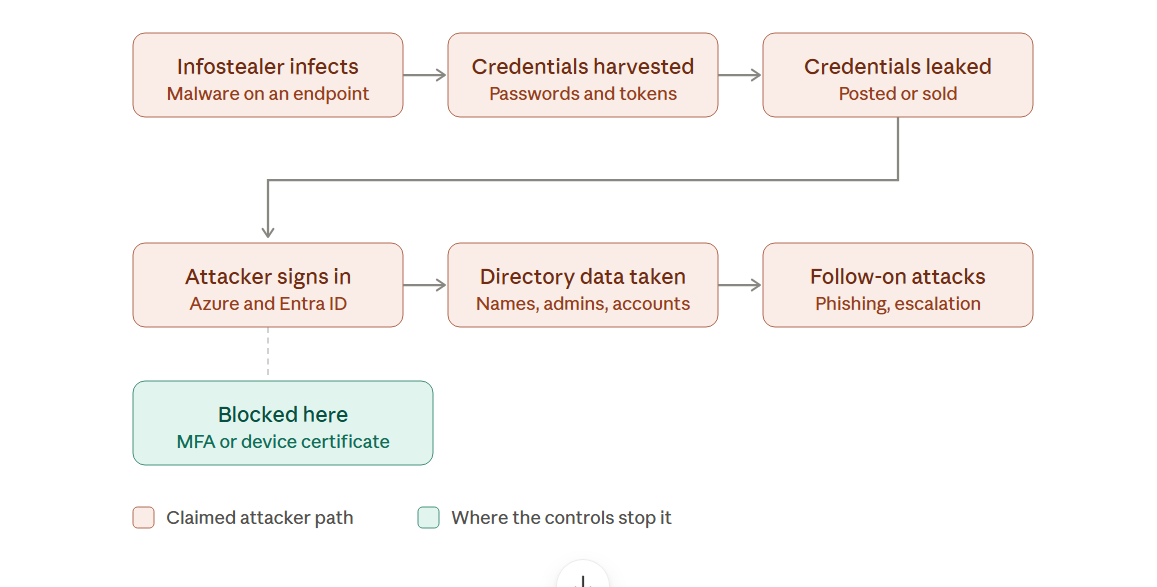
- The Claim: On Aug. 17, 2026, SecurityWeek reported the threat actor’s claim to have targeted nine organizations: McDonald’s Corporation, Tata Consultancy Services (TCS), Vodafone, HCL Technologies, InterContinental Hotels Group (IHG), Kyndryl, Gap Inc., Hexaware Technologies, and Wyndham Hotels. TCS has publicly stated that it found no credible evidence of a breach.
- Record Counts: The threat actor claims 1.7 million records for McDonald’s Corporation and 425,000 records for Vodafone. It further claims 800,000 records for TCS, 250,000 for HCL Technologies, and 185,000 for IHG. No specific figures appear for Kyndryl, Gap Inc., Hexaware Technologies, or Wyndham Hotels. Every statistic represents the attacker’s assertion rather than independently verified data.
- The Method: The threat actor says the data came from Microsoft Azure and Entra ID instances accessed with leaked credentials, and intelligence firm Hudson Rock said the credentials were likely stolen in a targeted infostealer campaign. SecurityWeek’s report describes no vulnerability in those platforms and attributes access to leaked credentials.
McDonald’s Corporation, Vodafone, TCS, HCL Technologies, IHG, Kyndryl, Gap Inc., Hexaware Technologies, and Wyndham Hotels have not confirmed specific claims regarding the breach scope or methodology.
See your security gap before attackers do.
See continuous trust in action on a platform that includes RADIUS, PKI and AI security.
Why Stolen Credentials Beat Perimeter Controls
A valid login mimics normal user activity, and perimeter tools cannot easily distinguish this traffic from legitimate requests. Attackers bypass firewalls and other perimeter controls by using stolen credentials that are trusted by the network.
SecurityWeek’s report describes no zero-day vulnerability or infrastructure flaw in cloud identity services. Instead, the threat actor reportedly used leaked credentials to sign in to Azure and Entra ID instances.
The exfiltrated payload contained employee directory data including names, physical addresses, phone numbers, job titles, and manager details. The payload also included user group membership records, service accounts, and highly privileged account information.
Hudson Rock highlighted that exposure of these specific assets provides a direct roadmap for social engineering or targeted privilege escalation attacks.
- Service account names show attackers which non-human accounts to target next.
- Global admin names reveal the hierarchy structure needed to escalate privileges quickly across organizational boundaries.
Perimeter controls rely heavily on verifying external threats, but remain blind to internal actors using valid tokens. Traditional network segmentation struggles when an attacker operates with authorized credentials from within a known user pool.
In order to mitigate risk, teams should focus on monitoring internal behavior patterns instead of just blocking inbound connections.
Credential Theft Prevention: Move Past Passwords
Two specific controls stop an exposed password from completing a sign-in on its own:
- Using phishing-resistant MFA to block login attempts that lack physical possession or biometric proof.
- Binding access to device certificates so a stolen password alone cannot complete sign-in.
These measures render stolen passwords useless before attackers reach their destination.
Phishing-Resistant MFA
The Cybersecurity and Infrastructure Security Agency (CISA) defines phishing-resistant multi-factor authentication (MFA) as the most secure form of MFA.
Phishing-resistant MFA tools include Fast IDentity Online (FIDO) security keys and public key infrastructure (PKI)-based smart cards, which CISA names as forms of phishing-resistant MFA.
Deploying phishing-resistant MFA tools means that a standard password remains useless when an attacker lacks physical possession or biometric proof to complete the handshake.
With the right tools in place, the stolen credentials mentioned in recent reports serve only as a starting point; they cannot trigger authentication without additional verification. Attackers attempting login with stolen passwords face immediate rejection if their devices lack approved hardware tokens. This architecture breaks the chain of compromise before attackers reach sensitive systems or privileged accounts.
Binding Access to Device Certificates
Requiring an X.509 certificate at login means attackers cannot replay stolen passwords from their own machines. They lack access to the device’s private key necessary for authentication. This binding means passwords an infostealer harvests from an endpoint are useless on the attacker’s own machines.
The great thing about certificates is that they are a phishing-resistant form of authentication — not sending credentials over the air. Hackers can’t do anything if they steal something like this. And the cryptography is locked onto a device, so you know if a certificate is shown, it is for sure this is a compliant device. – Micah Spady, Director of Product Marketing at SecureW2.
Note that relying solely on a device certificate does not constitute MFA. You must integrate it into an existing workflow alongside other authentication factors and continue enforcing strict credential theft prevention protocols.
Implementing real-time certificate revocation cuts off compromised devices when anomalies appear in sign-in logs or device health metrics.
Lessons for Security Teams
Security teams must treat infostealer exposure as if every saved credential on an infected endpoint has been breached:
1. Protect service accounts and global admin names immediately because their compromise provides a direct roadmap for social engineering or targeted privilege escalation attacks.
2. Monitor login attempts following any directory data leak to catch the wave of spear-phishing that typically follows an initial breach.
3. Revoke access tokens and certificates when a device is confirmed compromised so no active sessions remain on that hardware.
Remove passwords from the authentication path by binding identity proofs directly to X.509 certificate chains instead of relying on typed secrets. This stalls attackers because they cannot reuse stolen data against certificate-based authentication without the device.
The security plan that scales with you.
Our solutions can scale from mid-market to global enterprises. Compare options and see how our solutions protect you from costly breaches and ensure peace of mind.
Make Stolen Passwords Useless With SecureW2
SecureW2 removes typed passwords from network authentication.
JoinNow Dynamic PKI aggregates identity and access management (IAM), mobile device management (MDM), and extended detection and response (XDR) inputs to issue, renew, or revoke certificates in real time.
The system automatically revokes certificates when device compliance changes or security events occur, so a compromised or noncompliant device loses certificate-based access.
JoinNow Cloud RADIUS delivers certificate-based, passwordless authentication that validates user and device identity in real time. This solution integrates with Microsoft Entra ID (formerly Azure AD), Okta, and Google Workspace to make policy decisions across Wi-Fi, VPN, and network access.
Attackers cannot reuse a leaked password against certificate-based authentication without the device that holds the certificate.
Stop relying on passwords that infostealers steal every day. Schedule a demo to see how it works.
Frequently Asked Questions
Was Microsoft Azure hacked in this breach?
The report describes logins with leaked valid credentials and does not describe any vulnerability within Azure or Entra ID instances. The threat actor says attackers used leaked credentials to sign in to these platforms. Hudson Rock said credentials compromised in a targeted infostealer campaign were likely the entry vector.
What is the difference between credential theft and credential stuffing?
Credential theft obtains valid username and password pairs, while credential stuffing attempts automated login using those stolen pairs across many sites. This second method works because many users reuse passwords on different platforms.
How does an infostealer get credentials?
An unauthorized program installed locally harvests saved passwords and active session tokens directly from the user device storage or browser cache. These tools operate silently within trusted applications to capture authentication data before users can detect the malicious activity occurring on their machines. Security teams must monitor endpoints for signs of infostealer infections rather than focusing solely on network perimeters.
How do I know if my credentials were stolen?
Unexpected sign-in alerts, password reset emails, or official breach notifications serve as primary indicators that your account data has been compromised. Organizations often receive these warnings before users themselves notice unusual activity.
