
No Passwords or Shared Credentials with Lightspeed Systems Firewall
SecureW2 gives Lightspeed Systems the identity infrastructure it needs to enforce per-user filtering policy. Automate SSL inspection certificate deployment across every device fleet. Replace shared credentials with device-bound certificates that can’t be phished or passed around.
Overview
PKI and RADIUS Identity for Lightspeed Web Filtering
SecureW2 serves as the PKI and RADIUS layer for Lightspeed Systems in K-12 and education networks, issuing device-bound, phishing-resistant certificates via JoinNow onboarding. It automates SSL certificate deployment across various devices, ensuring trust and no browser warnings. JoinNow Cloud RADIUS evaluates user identity, role, and device posture at authentication to assign appropriate filtering policies, ensuring users receive correct content filtering based on verified identity, not shared credentials or IP address.
Use Cases
NPS / On-Premises RADIUS Replacement
Dynamic VLAN Assignment from Identity Attributes
How It Works
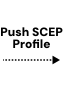
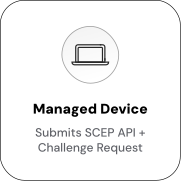
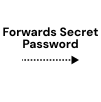
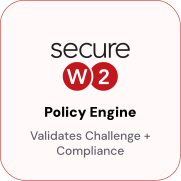
Two Paths to Trusted Identity in Lightspeed Systems
VPN Authentication Flow with Real-Time Identity Lookup
The device presents its certificate to the Lightspeed Systems’ VPN gateway, which forwards the request to Cloud RADIUS using RADIUS. Cloud RADIUS validates the certificate and performs a live identity provider lookup to confirm the user’s status and group membership. It returns a RADIUS Accept to the gateway, which establishes the encrypted tunnel. A deprovisioned user is blocked on subsequent connection attempts without certificate revocation.

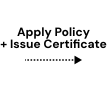
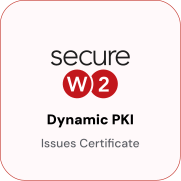
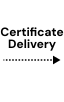
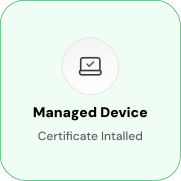


Certificate Distribution for SSL Inspection (SSLI)
JoinNow automates SSL inspection certificate distribution across Windows, macOS, iOS, Android, and ChromeOS through self-service onboarding. Devices receive and trust the Lightspeed Systems inspection certificate automatically, eliminating browser warnings and manual installation across managed and BYOD fleets.


Use Cases
Deployment & Architecture Detail
NPS / On-Premises RADIUS Replacement
Organizations running WPA2-Enterprise on Lightspeed Systems often depend on on-premises NPS servers and Active Directory Certificate Services to authenticate devices. SecureW2 eliminates that infrastructure dependency. Cloud RADIUS authenticates directly against the configured identity provider: no NPS, no domain controller, no AD CS in the path.
During enrollment, the Policy Engine validates user identity before issuing a certificate. At authentication time, Cloud RADIUS performs a live identity provider lookup, verifying account status and group membership, and returns the appropriate RADIUS response to Lightspeed. The full path runs through Cloud RADIUS and the identity provider, not on-premises infrastructure. NPS and AD CS can be decommissioned without affecting Wi-Fi or VPN access.
Branch offices and remote users authenticate the same way. Because the authentication path runs through Cloud RADIUS rather than on-premises servers, there is no dependency on domain controller reachability, VPN tunnels to reach NPS, or AD replication health.
Dynamic VLAN Assignment from Identity Attributes
Cloud RADIUS reads identity provider group membership at authentication time and maps group values to RADIUS policy attributes, including VLAN assignments. Each rule specifies a group condition and the RADIUS attributes to return when that condition is met.
Group-to-VLAN rules are defined once in Cloud RADIUS. Identity provider group management automatically drives network access. When a user moves between groups, the change takes effect at the next authentication event, no manual RADIUS policy changes required.
Frequently Asked Questions
Lightspeed Systems Integration — Common Questions
How long does it take to set up the SecureW2 and Lightspeed Systems Integration?
Most organizations can configure the integration in a single session by following our setup guide and working with our knowledgeable engineers. Once complete, users begin authenticating with certificates instead of passwords without requiring major changes to existing Lightspeed Systems configurations.
Which authentication protocols are supported?
Unlike Wi‑Fi enterprise networks, many VPNs, including Lightspeed Systems', do not yet natively support EAP‑TLS certificate authentication over RADIUS. To address this, SecureW2 provides two pathways. With Cloud RADIUS and MFA, VPN sessions can be authenticated via SAML, with users assigned a unique username/password and automatically prompted for MFA. Alternatively, with SecureW2 Managed PKI, organizations can integrate our certificate authorities directly into their firewall, establishing a certificate chain of trust without relying on EAP‑TLS. Both methods give administrators flexible, secure options for removing traditional passwords from the VPN login process.
How does passwordless VPN authentication look from the end-user perspective?
From the user's perspective, certificate provisioning for Lightspeed Systems is seamless, SecureW2 automatically installs the root CA certificate on student and staff devices, allowing Lightspeed Filter to inspect HTTPS web traffic without browser warnings. The difference is behind the scenes: instead of typing a username or password, the session is authenticated automatically with a certificate issued to their device. This creates a frictionless login experience where users connect instantly and securely, without having to remember or reset passwords.
How does certificate revocation work if a device is lost, stolen, or flagged by an EDR?
SecureW2 continuously manages the full lifecycle of VPN certificates. If a device is reported lost, stolen, or flagged by endpoint security tools, its certificate is revoked using cloud‑based PKI controls. Administrators can choose to suspend it temporarily (with the option to restore later) or revoke it fully, which updates the CRL and blocks VPN access. This minimizes exposure while giving IT teams flexible control to reinstate secure access once the device is remediated.
Does Lightspeed Systems support certificate-based RADIUS authentication?
SecureW2 provides the identity foundation via 802.1X EAP-TLS for campus Wi-Fi, sending User-to-IP mappings to Lightspeed Systems for seamless student policy enforcement.. SecureW2 provides two integration paths: using Cloud RADIUS with MFA to secure VPN logins with an identity‑bound, MFA‑protected credential, or deploying Managed PKI to establish a certificate trust chain within Lightspeed Systems. firewalls. Both methods provide strong security today and ensure that when Lightspeed Systems adds EAP‑TLS support in the future, your organization will already have the full PKI infrastructure in place.
Ready to Connect Lightspeed Systems to SecureW2?
Connect with our integration specialists to implement this solution in your environment and transform your security posture.