
Certificate-Based 802.1X Wi-Fi Security for Cambium Networks
Cambium APs act as 802.1X authenticators. SecureW2 provides the PKI and Cloud RADIUS that make EAP-TLS work. No passwords, no on-premise RADIUS server, no manual VLAN assignments. Certificate-based Wi-Fi is ready in hours.
Overview
Automate Device Compliance via Cloud-Native Certificate Lifecycles
SecureW2, the PKI and RADIUS layer for Cambium Networks, issues phishing-resistant certificates to all devices. It distributes them via JoinNow onboarding or MDM. Cambium access points act as 802.1X authenticators, forwarding EAP-TLS requests to JoinNow Cloud RADIUS. This validates certificates, assesses identity and device status, and returns an Access-Accept with VLAN info. Devices connect to the right network segment automatically, without separate SSIDs or manual configuration. The cloud-native approach removes the need for on-premise RADIUS servers, taking hours to set up. JoinNow Managed PKI handles renewal silently, with real-time revocation for non-compliant devices.
Use Cases
PSK and PEAP Replacement
Webhook-Based Certificate Lifecycle Automation
How It Works
From Enrollment to Authenticated Wi-Fi — No Passwords Required
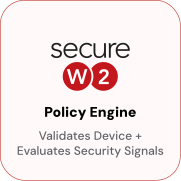
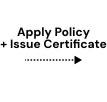
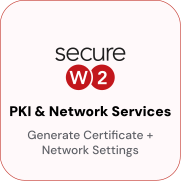
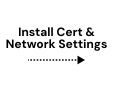
EAP-TLS 802.1X Authentication on Cambium Wi-Fi
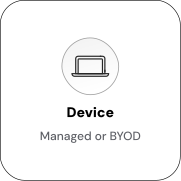
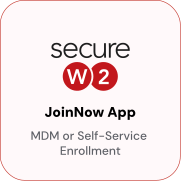
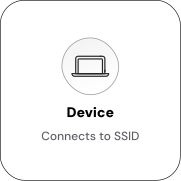
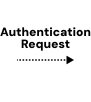
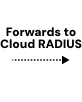
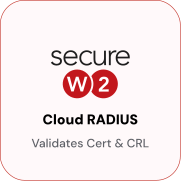
The device enrolls a certificate through JoinNow or MDM, then connects to the Cambium SSID. The Cambium AP proxies the EAP-TLS exchange to Cloud RADIUS, which validates the certificate and returns an Access-Accept. No password is entered at any step.

Dynamic VLAN Segmentation via Cloud RADIUS
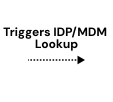
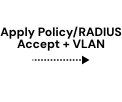
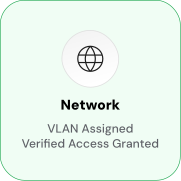
Cloud RADIUS evaluates user and device attributes at authentication time, maps them to VLAN assignment rules, and returns the VLAN attribute in the Access-Accept. The Cambium AP enforces the assignment immediately; staff, students, contractors, and BYOD are all served from a single 802.1X SSID.

Use Cases
Deployment & Architecture Detail
PSK and PEAP Replacement
Shared-password Wi-Fi , whether a single PSK broadcast across the organization or PEAP-MSCHAPv2 with user passwords, carries inherent risk. A compromised PSK grants access to any device. PEAP credentials can be phished through rogue access points. Certificates eliminate both attack surfaces.
With EAP-TLS, each device holds a unique certificate bound to its hardware credential store. There is no shared secret to steal and no password to phish. An attacker who captures network traffic gains no credential that can be replayed on another device. Cloud RADIUS validates the certificate's chain of trust, expiry, and revocation status at every connection attempt, then performs a live identity provider lookup to confirm the user is still active and authorized.
Webhook-Based Certificate Lifecycle Automation
SecureW2 manages the entire certificate lifecycle—issuance, renewal, and revocation—automatically without manual intervention on the Cambium AP. Certificates are issued with a configurable validity period and renewed automatically before expiry. On MDM-managed devices, renewal is pushed silently as a new profile, while on JoinNow-enrolled devices, the network profile triggers silent renewal, replacing the expiring certificate without user prompts. Suspension is immediate; if a device is flagged as non-compliant, lost, stolen, or unenrolled, SecureW2 disconnects the device in real time.
Cloud RADIUS checks the revocation list at each EAP-TLS authentication, denying access if revoked, with no action needed from the Cambium AP. This model removes the need for manual certificate management. Administrators set revocation policies based on IdP group membership, MDM compliance, or manual actions, with enforcement automatic across all Cambium APs.
Frequently Asked Questions
Cambium Networks Integration — Common Questions
How long does it take to set up SecureW2 with Cambium networks?
Setup time is measured in hours because SecureW2 eliminates the heavy lifting normally associated with building PKI and RADIUS infrastructure. By connecting Cambium directly to SecureW2’s Cloud RADIUS and integrating our Dynamic PKI with your environment, organizations can quickly enforce EAP-TLS for Wi-Fi and certificate-backed access for VPN. Once identity provider and MDM integrations are established, policy-based Zero Trust controls are applied in real time, dramatically accelerating the path to passwordless network access.
Which Cambium products are supported with SecureW2?
SecureW2 fully supports Cambium wireless access points. By integrating directly with Cambium's 802.1X infrastructure, SecureW2 provides certificate-based authentication for Wi-Fi, dynamic VLAN segmentation, and secure remote access. Whether the environment is a small branch deployment or a global distributed network, SecureW2’s cloud-native PKI and RADIUS scale seamlessly across all Cambium product lines without requiring additional hardware.
How are certificates deployed to devices in a Cambium environment?
Certificates are deployed through different methods depending on device ownership. For managed endpoints, SecureW2 integrates with MDM platforms such as Intune, Jamf, or Workspace ONE to silently issue and install certificates without user intervention. For unmanaged or BYOD devices, users are guided through SecureW2’s JoinNow onboarding client to complete a self-service enrollment workflow. In both cases, certificates are automatically delivered with the correct Cambium SSID settings so that devices can immediately connect using EAP‑TLS authentication.
How does certificate renewal and revocation work for Cambium Wi-Fi ?
In a Cambium deployment, SecureW2 continuously enforces Zero Trust by tying certificate renewal and revocation to user identity and device posture. Certificates are silently renewed in the background, ensuring uninterrupted access for trusted endpoints. If a device is compromised, unenrolled, or no longer compliant with MDM policies, SecureW2 can instantly revoke its certificate, blocking Wi‑Fi or wired connectivity. This prevents unauthorized access in real time without relying on weak credentials or manual IT intervention.
What authentication protocols are supported in Cambium deployments with SecureW2?
All of the key protocols a Cambium deployment requires are supported by SecureW2 out of the box. That includes EAP‑TLS (for Wi‑Fi and wired 802.1X), SAML 2.0 (for VPN), and onboarding standards like Dynamic SCEP and ACME. SecureW2 also integrates easily with OAuth 2.0 and OpenID Connect identity flows, ensuring customers can connect their existing IdPs and MDMs. This makes deploying certificate‑based authentication with Cambium networks both secure and straightforward.
Does SecureW2 support multi-tenant or multi-SSID Cambium environments (e.g., guest vs. corporate)?
Yes. SecureW2 supports both multi‑SSID and multi‑tenant Cambium deployments, a common requirement for universities and distributed enterprises. IT teams can map different SSIDs to different onboarding portals, certificate policies, and VLAN assignments, ensuring each user group or tenant has the right level of network access. This provides a scalable way to deliver secure Wi‑Fi and VPN access across large or complex Cambium environments.
Ready to Connect Cambium Networks Wi-Fi and VPN to SecureW2?
Connect with our integration specialists to implement this solution in your environment and transform your security posture.