Key Takeaways
- Zero trust network access is a security model that grants users access to specific applications based on verified identity and device context rather than placing them on an entire network.
- VPNs create an encrypted tunnel to a network and have been the dominant remote access technology for decades, but broad network access and infrequent re-authentication create significant exposure.
- ZTNA and VPN differ most sharply on access scope, authentication frequency, and attack surface, as the comparison table in this article details.
- VPN deployments carry growing security risk: 56% of organizations reported a cyberattack exploiting VPN vulnerabilities in 2024, and 53% of those breaches involved lateral movement.
- Certificate-based authentication strengthens both ZTNA and VPN deployments by replacing phishable passwords with hardware-bound credentials.
Remote access has always involved a tradeoff: connectivity vs. control.
Virtual private networks (VPNs) solved the connectivity problem for a generation of distributed workers, but that broad access comes with a widening attack surface as threat actors increasingly target VPN appliances.
Zero trust network access (ZTNA) takes a different approach, verifying every access request individually before granting the minimum access required.
This article breaks down how each model works, where they differ, and how to decide which one fits your environment.
What Is ZTNA vs. VPN?
Zero trust network access is a security framework that grants users access to specific applications or services only after continuously verifying identity, device health, and contextual signals, never placing the user on the broader network.
NIST SP 800-207 describes the underlying zero trust architecture (ZTA) as an approach that moves defenses from static, network-based perimeters to focus on users, assets, and resources, assuming no implicit trust is granted based on network location alone.
A virtual private network is a technology that creates an encrypted tunnel between a user’s device and a corporate network, routing traffic through that tunnel so the device appears to be on the local network. The IETF describes a VPN as a framework for using public or private networks to create groups of users separated from other network users that can communicate as if on a private network.
VPNs were designed when most applications lived in a corporate data center and most users worked from offices. ZTNA was built for environments where applications span data centers, SaaS platforms, and cloud infrastructure, and users connect from anywhere.
How Each Technology Works
VPNs and ZTNA both secure remote access, but they take fundamentally different paths to get there: one builds a tunnel to the network, the other brokers access to individual applications.
How a VPN Works
A VPN establishes a secure tunnel using protocols such as Internet Protocol Security (IPsec), Secure Sockets Layer (SSL)/Transport Layer Security (TLS), or WireGuard.
The general process follows these steps:
- The user authenticates, typically once, to a VPN concentrator or gateway.
- The VPN client creates an encrypted session between the device and that gateway.
- The gateway places the user on the corporate network segment, where the device appears to be local.
- From that point, the user can reach any resource the network allows, subject to firewall rules, until they disconnect.
This model creates broad lateral access. A compromised set of VPN credentials or a vulnerability in the VPN appliance itself gives an attacker the same network footprint as a legitimate user.
How ZTNA Works
ZTNA routes each access request through a policy engine before the request reaches the application. The policy engine checks:
- User identity: Verified against an identity provider (IdP) such as Entra ID or Okta.
- Device posture: The device must meet defined health criteria such as patch level, endpoint detection and response (EDR) status, and certificate presence.
- Context signals: Location, time of day, risk score from the security stack.
- Application entitlement: The user or device must be explicitly authorized for that specific application.
Only after all checks pass does the user receive a scoped connection to the target application. The underlying network infrastructure remains invisible to the user; no broad IP routing occurs. ZTNA solutions re-evaluate trust continuously throughout the session and can revoke access if posture degrades.
ZTNA vs. VPN: Key Differences
The table below compares the two models across the dimensions that matter most for IT and security teams.
| Dimension | VPN | ZTNA |
| Access scope | Full network segment or subnet | Specific application only |
| Trust model | Implicit trust after initial login | Continuous, explicit verification per request |
| Authentication frequency | Once per session | Continuous or per-request |
| Attack surface | Entire network reachable post-login | Only authorized application reachable |
| Lateral movement risk | High; compromised user can traverse the network | Low; user cannot reach unauthorized resources |
| Visibility | Limited to perimeter traffic logs | Per-application, per-session, per-user logs |
| Cloud compatibility | Limited; backhauling increases latency | Native; connects directly to cloud applications |
| Appliance exposure | VPN gateway is publicly addressable | No inbound ports on application infrastructure |
| User experience | Client installs required; latency from backhauling | Browser-based or lightweight agent; lower latency |
| Deployment complexity | Established; well-understood by IT teams | Newer; requires IdP and device management integration |
VPNs grant broad access that suits site-to-site connectivity; ZTNA suits granular, per-application access for distributed users and cloud workloads.
Security Risks of VPNs
VPN appliances have become a preferred target for attackers because they are publicly accessible, often run outdated firmware, and successful exploitation hands an attacker direct access to an internal network. The scale of that exposure is measurable.
In a 2024 survey of 647 IT professionals, 56% of organizations reported a cyberattack that exploited a VPN vulnerability in the prior year, up from 45% a year earlier. Of those breached, 53% said attackers moved laterally through their networks after exploiting the VPN.
Zscaler ThreatLabz 2024 VPN Risk Report
Several critical vulnerabilities illustrate a pattern. In early 2024, a chain involving CVE-2024-21887 and CVE-2023-46805 compromised roughly 2,000 Ivanti VPN devices across multiple sectors. CVE-2024-3400, a critical command injection flaw in Palo Alto PAN-OS GlobalProtect, received a CVSS score of 10.0 and enabled unauthenticated remote code execution.
ZTNA does not expose an appliance to the public internet the same way a VPN gateway does. Traffic flows from the user outward to a cloud broker or directly to the application, so there is no inbound port to scan or exploit at the network perimeter.
Advantages of ZTNA Over VPN
ZTNA’s advantages over VPN cluster around granting access to applications instead of networks. That change produces four distinct security and performance gains.
Least Privilege Access
ZTNA enforces least-privilege access at the application level. A contractor authorized for one SaaS tool cannot reach internal databases or file shares. VPNs, by contrast, typically grant access to a full network segment, and organizations frequently over-provision that access because narrowing it requires ongoing manual firewall rule management.
Continuous Trust Verification
ZTNA re-verifies user and device state throughout a session. If a device becomes unmanaged mid-session, for example because endpoint protection is disabled, the session can be terminated or downgraded automatically. A VPN session remains open as long as the initial authentication succeeded, regardless of what changes on the device afterward.
Better Performance for Cloud and SaaS
VPNs backhaul traffic through a corporate data center, adding latency for any application hosted outside that data center. ZTNA connects users directly to cloud applications through nearby points of presence or direct application connectors, reducing round-trip time. This matters for organizations that have moved workloads to AWS, Azure, or Microsoft 365.
Reduced Blast Radius
If a ZTNA session is compromised, the attacker can only reach the applications that the session was authorized to access. The rest of the environment remains unreachable. The same compromise under a VPN model grants access to every resource the network firewall permits for that subnet.
Where VPNs Still Make Sense
ZTNA is not a universal replacement in every scenario. VPNs remain the right tool for several use cases:
- Site-to-site connectivity: Connecting two office networks or a branch office to a data center is still commonly handled by IPsec VPN tunnels. ZTNA is designed for user-to-application access, not network-to-network bridging.
- Legacy application access: Some applications cannot be put behind a ZTNA proxy because they rely on protocols or port ranges that ZTNA solutions do not support without modification.
- Established small environments: Organizations with a small headcount, a single on-premises environment, and no cloud footprint may find VPN sufficient for their current risk posture, though migration planning is still worthwhile.
Many organizations run both. ZTNA handles cloud and SaaS access while VPN handles site-to-site or legacy application connectivity. The migration path typically starts with the highest-risk, internet-facing use cases and moves toward broader ZTNA coverage over time.
ZTNA Market Momentum
ZTNA adoption is climbing steadily, and the market data reflects it. Analysts valued the global ZTNA market at roughly $2.2 billion in 2025 and project it to reach $25.2 billion by 2035, a compound annual growth rate of 27.6% over that period.
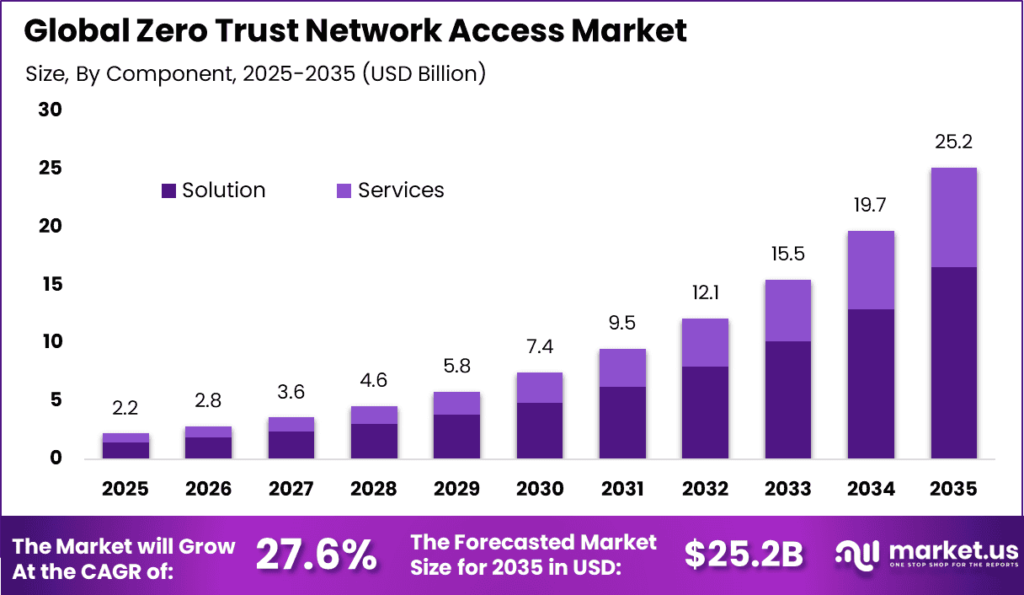
Enterprise is following a similar curve. Research from Market.us Scoop shows that close to 68% of enterprises are now using or actively adopting ZTNA to replace or complement their traditional VPN infrastructure.
That shift has come with measurable security gains: organizations moving to ZTNA have reported roughly 58% fewer successful phishing incidents and nearly 45% less lateral movement during breaches, pointing to tighter access control and better threat containment.
This change is driven by the documented failure rate of perimeter-based models under the current threat environment, combined with the shift to hybrid work and cloud infrastructure that makes broad-network VPN access operationally burdensome. As applications spread across data centers, SaaS platforms, and cloud environments, the broad-tunnel VPN model becomes both a security liability and an administrative one.
The Role of Certificate-Based Authentication in Both Models
Whether an organization uses ZTNA, VPN, or both, the strength of authentication at the point of access largely determines the security outcome.
A certificate bound to a specific device can’t be phished, shared, or replayed in transit. Whether it’s securing a VPN or feeding a ZTNA policy engine, it proves identity and device ownership in a single step.
Certificate-based 802.1X authentication is well-established for wired and wireless network access. The same principle applies to VPN and ZTNA endpoints: when a user’s device presents a certificate issued by a trusted certificate authority (CA) rather than a password, the authentication cannot be replayed or stolen in transit.
EAP-TLS, the extensible authentication protocol (EAP) method that uses mutual certificate authentication, eliminates the password entirely from the authentication exchange. A device enrolled with a valid certificate from the organization’s public key infrastructure (PKI) proves both identity and device ownership simultaneously.
For VPN deployments, replacing credential-based authentication with certificate authentication through JoinNow Dynamic PKI closes the credential-theft vector that accounts for a large share of VPN breaches. For ZTNA deployments, certificates serve as one of the device-posture signals the policy engine evaluates on every access request.
How SecureW2 Strengthens ZTNA and VPN Deployments
SecureW2 JoinNow Cloud RADIUS and JoinNow Dynamic PKI address the authentication layer that both ZTNA and VPN frameworks depend on. Rather than relying on passwords that can be phished or shared, the JoinNow Platform issues hardware-bound X.509 certificates to every managed device and bring your own device (BYOD) system. Those certificates feed the continuous trust evaluation that ZTNA policy engines require.
Cloud RADIUS performs real-time identity lookups against Entra ID, Okta, and other identity providers at the moment of authentication, confirming that a user is still active and the device is still managed before the VPN or ZTNA session is established. Because that lookup happens on every authentication, access revocation when an employee is offboarded or a device is compromised takes effect immediately rather than waiting for a session to expire.
For organizations planning to move from VPN to ZTNA incrementally, the JoinNow Platform integrates with a wide range of ZTNA and VPN vendors, including Zscaler, without requiring a rip-and-replace of the existing network stack.
Schedule a demo to see how certificate-based authentication works across both VPN and ZTNA environments.
Frequently Asked Questions
Can ZTNA fully replace a VPN?
ZTNA can replace VPN for most user-to-application remote access scenarios, but it is not a complete substitute for site-to-site network connectivity. Organizations with on-premises applications that require full IP routing or that use legacy protocols may need to run VPN alongside ZTNA for those specific use cases while migrating other workloads to ZTNA first.
What are the main disadvantages of ZTNA?
ZTNA requires integration with an identity provider, a device management platform, and application connectors for each protected resource. That setup is more complex than deploying a single VPN gateway. Organizations without mature identity or device management infrastructure will face additional groundwork before ZTNA delivers its full security benefit. Cost is also a factor, since ZTNA is typically sold as a SaaS subscription with per-user pricing, whereas a VPN appliance has a one-time hardware cost even if ongoing licensing applies.
Is ZTNA more secure than a VPN?
For user-to-application access, ZTNA provides a substantially smaller attack surface. It never places users on the broader network, continuously verifies device and user state, and exposes no inbound ports on application infrastructure. VPNs expose a publicly reachable gateway, authenticate users once per session, and grant broad network access.
What is the difference between a VPN and zero trust?
Zero trust is a security philosophy, not a product. It holds that no user or device should be trusted by default, regardless of whether it is inside or outside a network perimeter. VPN is a specific technology that contradicts the zero trust principle by granting broad implicit trust to anyone who successfully authenticates. ZTNA is the technology category that operationalizes zero trust principles for remote access, replacing the broad-tunnel model with continuous, per-application access control.
Does ZTNA work for on-premises applications, or only cloud apps?
ZTNA works for both. While it's often associated with cloud and SaaS access, ZTNA connectors can broker access to applications hosted in a private data center just as they do for cloud-hosted ones; the user still reaches the specific application without being placed on the network. The main exceptions are legacy applications that rely on protocols or port ranges a ZTNA proxy can't handle, which may still require a VPN.
